E-mail: marketing@hbhuamei.com
When planning a solar greenhouse, many users first ask a practical question: should I choose a passive solar greenhouse or an active solar greenhouse?
Both systems use solar energy, but they work in different ways. A passive solar greenhouse relies mainly on structure, orientation, insulation materials, heat storage, and airtight design to collect and retain solar heat. An active solar greenhouse uses solar panels, pumps, fans, sensors, batteries, or mechanical systems to collect, move, store, and control heat.
The difference is not simply “old design versus new technology.” It is a difference in heating logic. A passive solar greenhouse tries to reduce energy demand through the greenhouse structure itself. An active solar greenhouse uses equipment to supply or distribute energy more actively.
For greenhouse builders, agricultural project planners, and facility investors, understanding passive solar greenhouse vs active solar greenhouse is important before choosing a structure, material system, and budget plan.
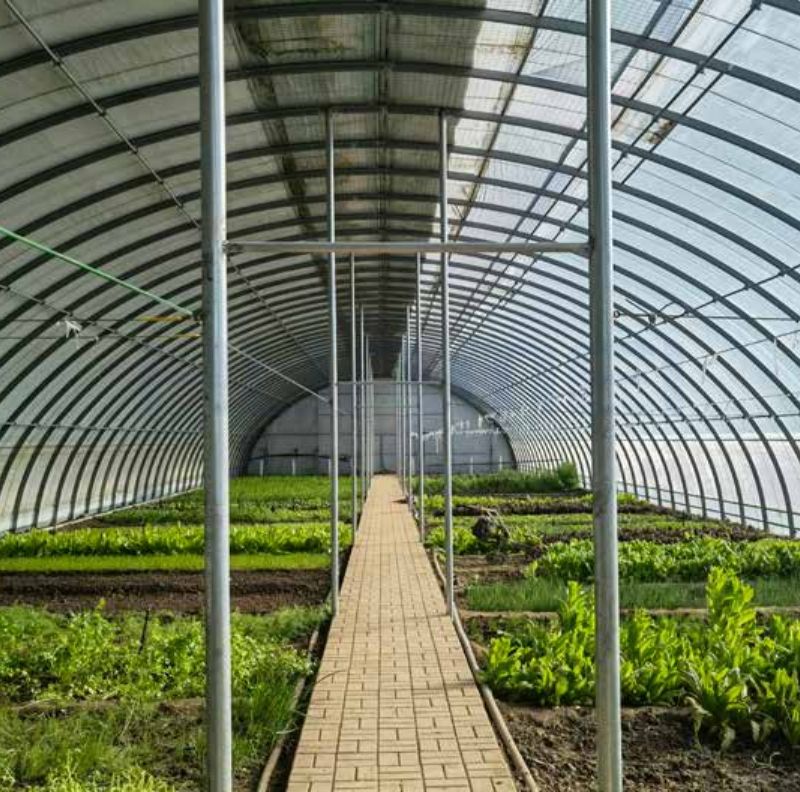
A passive solar greenhouse is a greenhouse that uses sunlight as the main heat source without depending heavily on powered heating equipment. It collects solar energy through the transparent surface, stores heat in walls, soil, water, or other thermal mass, and reduces heat loss through greenhouse insulation materials.
The core of a passive solar greenhouse is structural energy efficiency. Instead of adding more heating equipment, the design focuses on capturing heat, storing heat, and slowing heat loss.
A typical passive solar greenhouse may include:
A sun-facing transparent roof or front surface
An insulated rear wall or side wall
High-performance greenhouse insulation materials
Thermal mass for heat storage
A greenhouse insulation quilt for night-time heat retention
Airtight doors, vents, joints, and panel connections
A foundation design that reduces cold bridging
Optional air-soil heat exchange or underground heat storage
In this type of solar greenhouse structure, materials are extremely important. The wall, insulation layer, quilt, covering, frame, and sealing system all affect the actual thermal performance.
An active solar greenhouse also uses solar energy, but it depends more on equipment. Instead of relying only on the structure, an active solar greenhouse usually includes mechanical or electrical components to collect, convert, move, or store solar energy.
An active solar greenhouse may use photovoltaic panels to generate electricity. That electricity can power fans, pumps, heaters, vents, sensors, control systems, or water circulation systems. Some active solar greenhouse systems use solar thermal collectors to heat water or air, then distribute that heat inside the greenhouse.
Common components of an active solar greenhouse may include:
Solar photovoltaic panels
Solar thermal collectors
Circulation pumps
Air fans
Water tanks
Batteries or energy storage systems
Temperature sensors
Automatic ventilation systems
Intelligent greenhouse control systems
Auxiliary heating equipment
An active solar greenhouse can provide more control, but it also has higher equipment complexity. It may require more installation planning, maintenance, and system management.
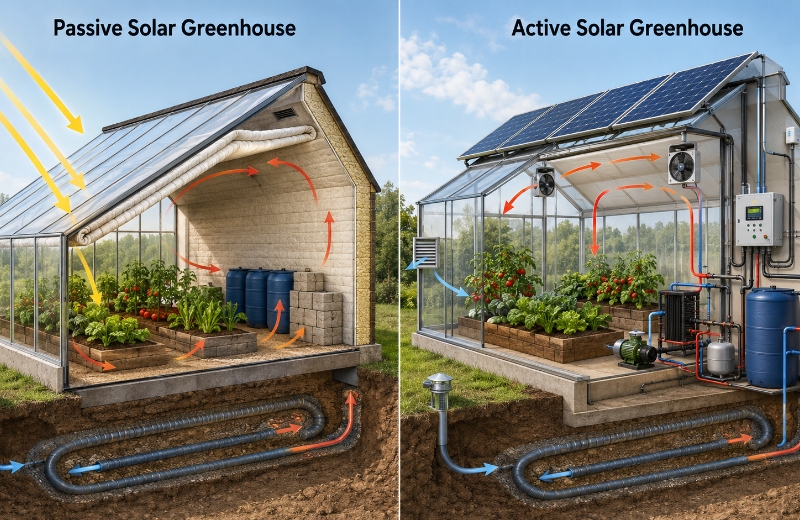
The core difference between a passive solar greenhouse and an active solar greenhouse is how they manage heat.
A passive solar greenhouse uses the building structure itself as the heating system. The greenhouse collects sunlight, stores heat in thermal mass, and keeps heat inside through insulation and sealing.
An active solar greenhouse uses equipment to collect, transfer, and regulate heat. Solar panels, fans, pumps, batteries, and control systems help manage the greenhouse environment more actively.
In simple terms:
A passive solar greenhouse asks:
“How can the greenhouse structure naturally collect and retain heat?”
An active solar greenhouse asks:
“How can solar-powered equipment help control the greenhouse environment?”
Both approaches can be useful. The right choice depends on climate, project budget, operating requirements, energy access, maintenance capacity, and the desired level of environmental control.
The structure of a passive solar greenhouse is usually designed around heat retention. It often has a strong insulated wall, optimized solar-facing surface, thermal mass, and a compact layout that reduces heat loss.
The structure of an active solar greenhouse may look similar to a standard greenhouse, but it includes additional equipment zones. These may include solar panel mounting areas, battery storage, control cabinets, water tanks, pipe systems, fans, and sensor networks.
A passive solar greenhouse depends more on the wall system, covering system, and insulation system. An active solar greenhouse depends more on the energy system and control system.
For this reason, passive solar greenhouse design usually places more emphasis on:
Orientation
Wall insulation
Heat storage
Airtightness
Thermal mass
Insulation quilt design
Low heat-loss structure
Active solar greenhouse design usually places more emphasis on:
Solar power generation
Energy storage
Air or water circulation
Automatic controls
Sensor layout
System maintenance access
Backup energy planning
From a construction perspective, a passive solar greenhouse may have a simpler operating system but requires careful structural and material design from the beginning.
Materials are central to the performance of a passive solar greenhouse. Since the system relies on natural heat collection and heat retention, the insulation materials must perform well over a long period.
Important materials in a passive solar greenhouse include greenhouse insulation materials, insulated wall panels, closed-cell foam insulation, reflective films, thermal mass materials, waterproof insulation quilts, sealing tapes, and durable structural frames.
In an active solar greenhouse, materials are still important, but equipment becomes equally important. Solar panels, pumps, fans, controllers, storage batteries, and sensors may determine how well the active system performs.
For a passive solar greenhouse, high-performance insulation materials are especially valuable because they reduce night-time heat loss. If the insulation wall, insulation quilt, or sealing system performs poorly, solar heat collected during the day can be lost quickly.
For an active solar greenhouse, the insulation level also matters. Even if the greenhouse has solar-powered heating equipment, poor insulation will increase the energy load. In other words, active systems still benefit from passive solar greenhouse principles.
This is why many modern solar greenhouse projects combine passive and active ideas. The structure uses strong insulation and thermal mass, while equipment provides supplementary control when needed.
The heating logic of a passive solar greenhouse can be described in four steps:
Collect solar heat through the transparent surface.
Store heat in walls, soil, water, or thermal mass.
Reduce heat loss through insulation materials and airtight structure.
Release stored heat when the temperature drops.
The heating logic of an active solar greenhouse is different:
Collect solar energy through photovoltaic panels or solar thermal collectors.
Convert or transfer that energy through equipment.
Store energy in batteries, water tanks, or other systems.
Use fans, pumps, heaters, or controls to distribute heat.
A passive solar greenhouse is more structure-driven. An active solar greenhouse is more equipment-driven.
This does not mean one is always better than the other. A passive solar greenhouse is often better for low-energy, low-maintenance projects. An active solar greenhouse may be better when precise temperature control, automation, or year-round intensive operation is required.
A major advantage of a passive solar greenhouse is low operating energy demand. Because it uses sunlight, heat storage, insulation, and natural heat retention, it can reduce the need for electric heating or fuel-based heating.
An active solar greenhouse can also reduce grid electricity use, but it usually requires solar equipment, batteries, pumps, fans, controllers, and possible maintenance. These systems may lower long-term energy costs, but the initial investment can be higher.
For users asking about greenhouse heating without electricity, a passive solar greenhouse is usually the first solution to consider. It can provide a stable thermal foundation before any active system is added.
For larger projects, an active solar greenhouse may be useful when passive heating alone is not enough. However, even in active systems, good greenhouse thermal insulation remains essential. Without insulation, any heating system becomes less efficient.
A passive solar greenhouse usually has fewer mechanical parts. This means fewer components that can fail. Maintenance mainly focuses on the structure, insulation materials, covering surface, sealing system, doors, vents, insulation quilt, and foundation.
An active solar greenhouse requires more technical maintenance. Solar panels, batteries, pumps, fans, sensors, wiring, and controllers all need inspection and occasional replacement.
This difference is important for remote agricultural projects or areas where technical maintenance may be difficult. A passive solar greenhouse can be easier to operate because its main performance comes from structure and materials rather than powered equipment.
However, active solar greenhouse systems can provide greater control when properly maintained. For projects that require automated monitoring and adjustment, active systems may offer more flexibility.
A passive solar greenhouse is especially suitable for areas with good winter sunlight, large day-night temperature differences, and a need to reduce heating energy demand. It works well when the structure is designed to maximize solar gain and minimize heat loss.
In colder or cloudier regions, a passive solar greenhouse still provides value, but it may need stronger insulation, more thermal mass, better sealing, and possibly auxiliary support. The insulation wall and greenhouse insulation quilt become especially important in these conditions.
An active solar greenhouse may be more suitable for projects that need higher control under unstable weather conditions. If solar panels, batteries, and backup systems are available, active systems can help regulate temperature, ventilation, and humidity more precisely.
In practice, climate suitability should not be judged only by temperature. Sunlight availability, wind exposure, snow load, humidity, and construction site conditions should also be considered.
A passive solar greenhouse may require careful investment in structure and materials at the beginning. High-performance insulation materials, insulated walls, thermal mass design, airtight joints, and insulation quilts may increase the initial material cost compared with a simple greenhouse.
However, the operating cost of a passive solar greenhouse is usually lower because it reduces dependence on electric heaters and mechanical systems.
An active solar greenhouse usually has higher equipment cost. Solar panels, batteries, pumps, fans, controllers, wiring, and installation can increase the project budget. Maintenance and replacement costs should also be considered.
From a long-term perspective, the better choice depends on the project goal. If the goal is to reduce energy dependence with a simpler structure, a passive solar greenhouse may be more practical. If the goal is automation and precise control, an active solar greenhouse may be more suitable.
Even if a greenhouse uses active solar equipment, insulation remains important. Solar panels and heating equipment can supply energy, but poor insulation will waste that energy quickly.
This is why active solar greenhouse design should still borrow from passive solar greenhouse principles. The better the greenhouse insulation materials, airtightness, thermal mass, and night-time heat protection, the less energy the active system needs.
In this sense, a passive solar greenhouse is not only one type of greenhouse. It is also a design principle that can improve almost any solar greenhouse system.
High-performance insulation walls, waterproof insulation quilts, sealed joints, and cold-bridge reduction can all improve greenhouse thermal performance, whether the system is passive or active.
The main difference between a passive solar greenhouse and an active solar greenhouse is the source of control.
A passive solar greenhouse depends on structure, materials, solar gain, thermal mass, insulation, and airtight design. It is best for low-energy, low-maintenance, and electricity-saving greenhouse projects.
An active solar greenhouse depends on solar equipment, pumps, fans, batteries, sensors, and control systems. It is best for projects that require automation, precise management, and stronger environmental control.
However, the two approaches are not competitors in every case. A well-designed greenhouse can use passive solar greenhouse principles as the foundation and active solar systems as support.
For most energy-saving greenhouse projects, the structure should come first. If the greenhouse cannot retain heat, even the best active system will work harder than necessary. A strong passive solar greenhouse structure with reliable greenhouse insulation materials can reduce heating demand, improve stability, and create a better foundation for long-term operation.
Q:What is the main difference between a passive solar greenhouse and an active solar greenhouse?
A:A passive solar greenhouse uses structure, insulation, thermal mass, and airtight design to collect and retain solar heat. An active solar greenhouse uses equipment such as solar panels, pumps, fans, batteries, and sensors to control heat and airflow.
Q:Is a passive solar greenhouse better than an active solar greenhouse?
A:A passive solar greenhouse is better for low-energy and low-maintenance projects. An active solar greenhouse is better when precise control and automation are required.
Q:Can an active solar greenhouse work without insulation?
A;It can work, but it will be less efficient. Even an active solar greenhouse needs good greenhouse insulation materials to reduce heat loss and lower energy demand.
Q:Is a passive solar greenhouse suitable for cold regions?
A:Yes, but it must be designed carefully. A passive solar greenhouse in cold regions needs strong insulation, good sealing, thermal mass, and an effective insulation quilt.
Q:Can I combine passive and active solar greenhouse systems?
A:Yes. Many modern greenhouse projects combine a passive solar greenhouse structure with active solar equipment for better efficiency and control.
Q:Which greenhouse is cheaper to operate?
A:A passive solar greenhouse is usually cheaper to operate because it relies more on sunlight, insulation, and thermal storage rather than powered equipment.
Contact Us
Insulation solutions LIST
Rubber foam tubeGlass wool InsulationCryogenic Rubber Foam SupplierHow to Choose Insulation for Roof SystemsTop 10 Soundproofing Insulation Materials: Comparing Effectiveness and CostThe Cheapest Insulated Shed – Affordable and High-Quality SolutionsPerformance of Colorful Rubber Foam under High and Low TemperaturesSound Absorbing Foam: Enhancing Acoustics and Noise ControlHow To Choose The Right Rock Wool Insulation For Your ProjectXPS Insulation for Cold Storage FloorsPassive Solar Greenhouse vs Active Solar GreenhouseClass 1 Rubber Foam ApplicationHuamei Sound Insulation SolutionsInsulation Solutions:A Comprehensive Guide to InsulationPassive Solar Greenhouse: How to Heat a Greenhouse Without ElectricityEPDM Rubber Foam ManufacturerHVAC InsulationAcoustic Cotton Supplier: Why Huamei is the Ideal ChoiceHow to Improve the Durability and Appearance of Colorful Rubber FoamGlass Wool PipeHuamei Air Conditioning Energy Saving System SolutionGreen Foam Board InsulationRubber Foam ManufacturerHigh-temperature Insulation glass wool applianceChina Rubber Foam Supplier - Why choose us?Concrete Roof Thermal Insulation BoardsFoil-clad Glass Wool SuppliersRubber Foam InsulationPolystyrene roof InsulationCan EPDM Rubber Foam Be Customized?Thermal Insulation Solutions for Steel Structure BuildingsGlass Wool Pipe for SaleChoose the right rubber foam for youHow to Prevent Condensation on Cold Water Pipes?Does Cryogenic Rubber Foam Resist Condensation and Moisture?Colorful Rubber Foam vs EVA Foam: Material and Performance ComparisonFormaldehyde Free Insulation ManufacturerClass 1 Rubber Foam manufacturerGlass Wool SupplierXPS vs Rock Wool: Different Applications and UsesHuamei Class 0 Rubber FoamSound Absorbing FoamWhere to Buy XPS Panels?Colorful Rubber Foam ProductsHVAC Insulation Material Comparison: Choosing the Best Solution for Your SystemCopyright © Huamei Energy-saving Technology Group Co., Ltd. All Rights Reserved | Sitemap | Privacy Policy
Insulation solutions LIST: Insulation solutions LIST