E-mail: marketing@hbhuamei.com
Airports are among the most demanding public infrastructure projects in the world. Unlike ordinary commercial buildings, airport terminals, concourses, baggage areas, utility rooms, air-conditioning systems, and service corridors operate for long hours, receive large passenger flows, and require stable indoor comfort across wide open spaces. For airport owners, contractors, HVAC engineers, and building material buyers, thermal insulation is not only a construction detail. It is a core part of airport energy-saving solution design.
As global air travel continues to expand, new airport construction and airport renovation projects are placing higher requirements on energy efficiency, fire safety, acoustic comfort, indoor air quality, and long-term building durability. According to ACI World, global passenger traffic is expected to continue growing significantly in the coming decades, while airport infrastructure investment will remain a major priority worldwide. At the same time, the building sector remains one of the largest sources of energy demand, making energy-efficient materials increasingly important for public transport infrastructure.
For airport projects, the selection of Airport thermal insulation materials directly affects HVAC performance, condensation control, fire protection, passenger comfort, and long-term operation costs. Huamei provides integrated insulation solutions using rubber foam, glass wool, and rock wool panels to support different functional areas of airport construction.
Airport buildings usually include large-span terminal halls, high ceilings, extensive glass façades, long air duct networks, chilled water pipelines, equipment rooms, curtain walls, roof systems, and internal partitions. These areas create complex thermal loads and make airport energy management more difficult than standard buildings.
In many terminals, HVAC systems need to respond quickly to changing passenger density, outdoor temperature, solar radiation, humidity, and flight schedules. Large open halls and glazed façades can cause uneven heat distribution, while chilled water systems and condensate pipes face a high risk of surface condensation if insulation is not properly designed. Poor insulation may lead to higher cooling and heating loads, energy waste, water dripping, mold risk, noise transmission, and reduced comfort.
A professional Airport energy-saving solution should therefore address several engineering goals at the same time:
Thermal efficiency: reducing heat gain or heat loss through ducts, pipes, roofs, walls, and equipment areas.
Condensation control: preventing moisture problems on chilled water pipes, air-conditioning ducts, and condensate systems.
Fire safety: improving passive fire protection in public buildings with high passenger density.
Acoustic comfort: reducing mechanical noise, rain noise, equipment vibration, and sound transmission in terminal spaces.
Durability: supporting long service life under continuous operation, maintenance activities, and changing climate conditions.
Construction efficiency: enabling easier installation across large-scale airport projects with complex schedules.
Huamei’s airport insulation approach combines rubber foam, glass wool, and rock wool panels according to the functional requirements of each airport area.
Rubber foam insulation plays a critical role in airport HVAC systems, especially for chilled water pipes, condensate pipes, air-conditioning ducts, valves, and mechanical service areas. In airport buildings, cooling systems often operate for long hours, and condensation control is essential for maintaining safe and clean indoor environments.
Huamei rubber foam is suitable for airport HVAC insulation because of its flexible structure, low heat transfer performance, moisture resistance, and ease of installation around pipes and irregular surfaces. Its closed-cell structure helps reduce vapor penetration and supports stable temperature control in chilled water and air-conditioning systems.
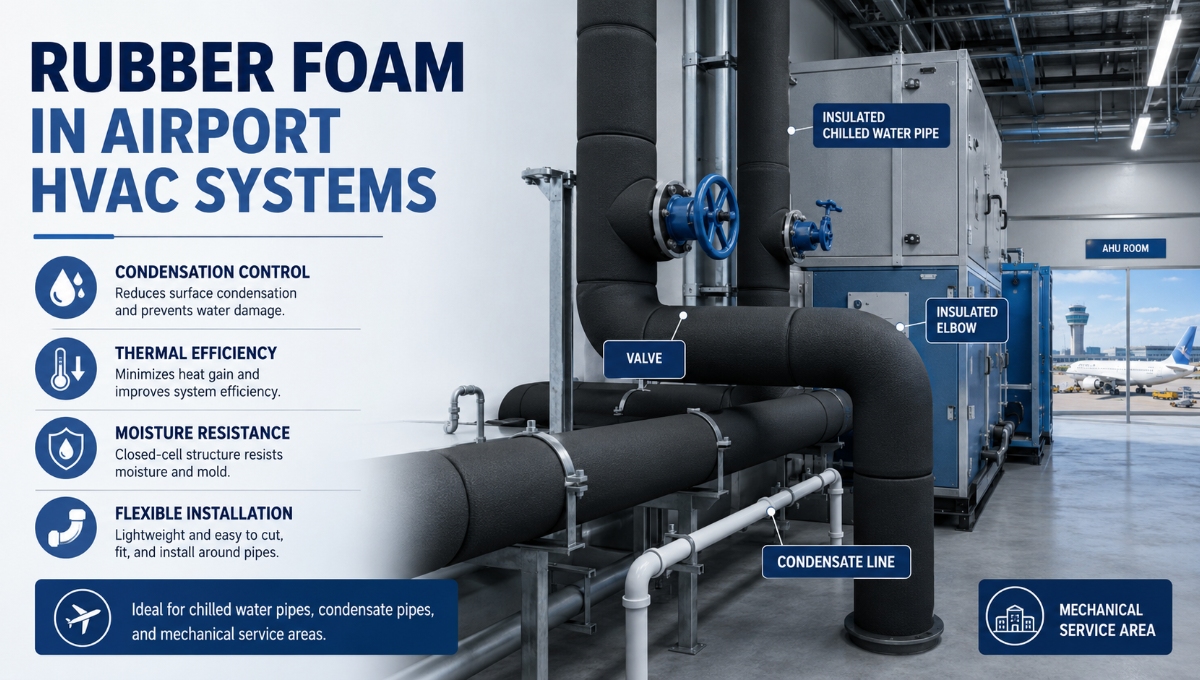
In an airport thermal insulation design, rubber foam is commonly used for:
Chilled water pipelines in central air-conditioning systems.
Condensate pipes connected to air-handling units and fan coil units.
Air-conditioning ducts in service corridors and equipment zones.
Valve boxes, elbows, flanges, and irregular HVAC components.
Mechanical rooms where thermal loss and condensation must be controlled.
For airport operators, the practical value of rubber foam insulation is clear: it helps reduce cooling loss, prevents condensation dripping, protects HVAC equipment, and supports stable indoor comfort in passenger areas. In hot and humid climates, rubber foam becomes especially important because condensation risk is higher and cooling systems often operate intensively.
Glass wool is widely used in airport buildings because it combines thermal insulation, acoustic absorption, fire resistance, and lightweight installation advantages. Airport terminals are often large, noisy, and mechanically complex. Passenger announcements, baggage systems, HVAC equipment, aircraft movement, and public circulation can all contribute to a noisy indoor environment. This makes acoustic performance an important part of airport insulation design.
Huamei glass wool can be applied in airport roof systems, ceilings, partitions, HVAC ducts, and large-space building envelopes. Its fiber structure creates air pockets that help slow heat transfer and absorb sound energy. This makes glass wool suitable for projects where both energy efficiency and comfort are required.
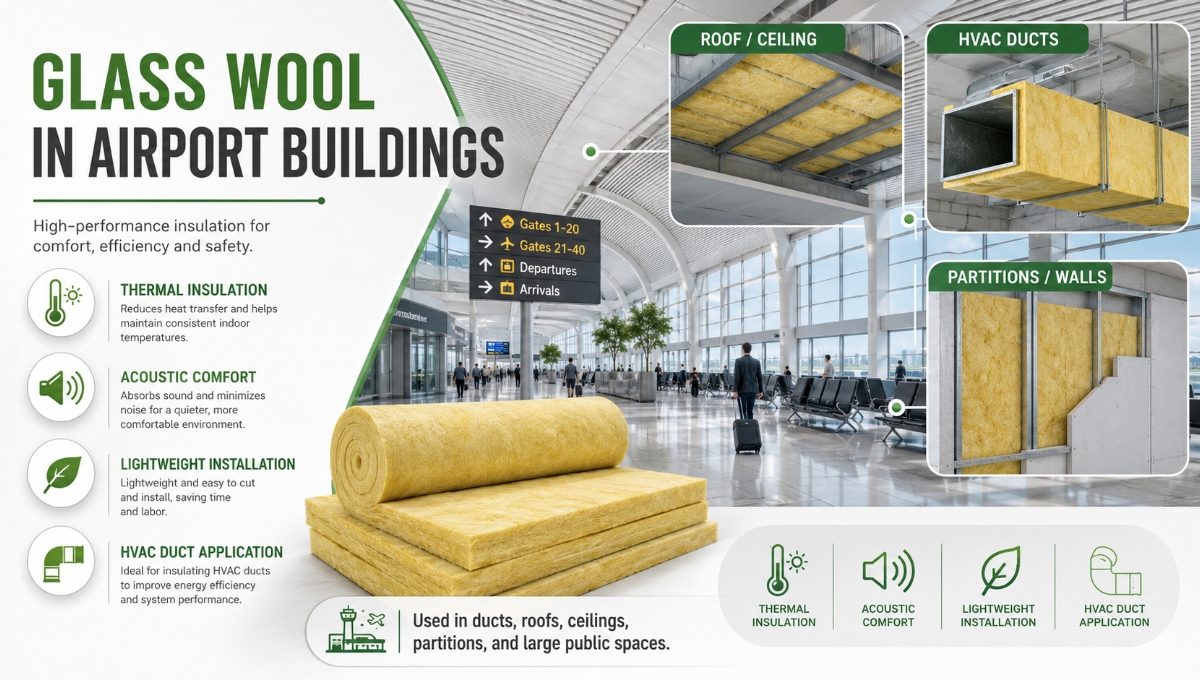
In airport construction, glass wool is commonly used for:
Duct insulation in ventilation and air-conditioning systems.
Terminal ceiling and roof insulation.
Interior wall and partition insulation.
Back-of-house areas, service corridors, and technical zones.
Large-span public spaces that require both thermal and sound absorption performance.
For airports, glass wool supports energy saving by reducing heat transfer through ducts and building envelopes. At the same time, it helps improve the passenger experience by controlling noise levels in terminal spaces. This dual function makes glass wool one of the most practical Airport thermal insulation materials for large public transportation buildings.
Rock wool panels are especially important in airport construction where fire safety, dimensional stability, compressive strength, and building envelope performance are required. Airports are high-occupancy public buildings, so passive fire protection is a critical design consideration. In areas such as curtain walls, roofs, fire-rated partitions, equipment rooms, and technical zones, rock wool panels provide strong functional value.
Huamei rock wool panels are made from basalt, dolomite, and other mineral raw materials through high-temperature melting and fiber-forming processes. Their non-combustible mineral structure makes them suitable for fire-resistant applications, while their density and stability support long-term performance in demanding building areas.
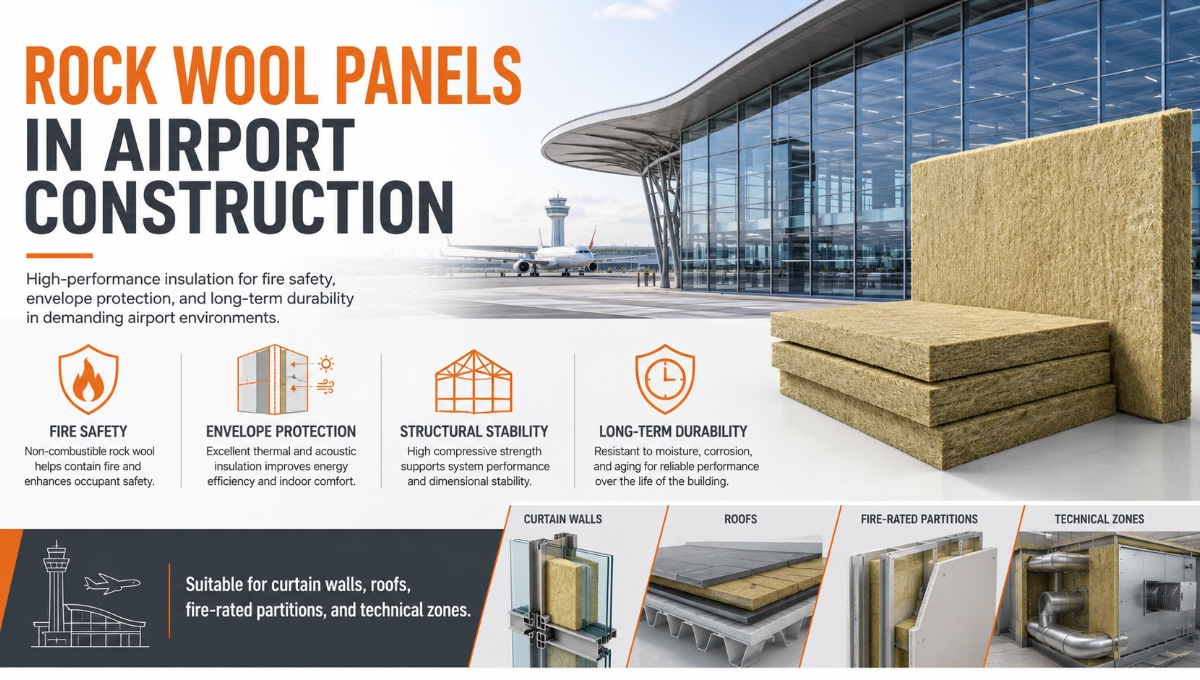
In airport projects, rock wool panels are commonly used for:
Curtain wall fireproof insulation.
Roof insulation systems.
Fire-rated internal partitions.
Equipment rooms and electrical rooms.
Composite sandwich panels and technical building areas.
Compared with insulation materials used mainly for HVAC or acoustic comfort, rock wool panels are positioned more strongly toward fire protection, envelope safety, and structural durability. They are often selected where the project requires insulation performance together with fire resistance and long-term building protection.
A well-designed Airport energy-saving solution does not rely on one insulation material for every area. Instead, each material should be selected according to its functional strength.
| Airport Area | Recommended Material | Main Function |
|---|---|---|
| Chilled water pipes and condensate pipes | Rubber foam | Condensation control, thermal insulation, energy saving |
| HVAC ducts and air-conditioning systems | Rubber foam / glass wool | Reduce cooling loss, improve duct efficiency, control noise |
| Terminal ceilings and roof areas | Glass wool / rock wool panels | Thermal insulation, acoustic comfort, fire resistance |
| Curtain walls and external walls | Rock wool panels | Fire protection, envelope insulation, durability |
| Interior partitions and technical rooms | Glass wool / rock wool panels | Sound absorption, fire resistance, thermal control |
| Mechanical and equipment rooms | Rubber foam / rock wool panels | Pipe insulation, equipment protection, fire-safe separation |
This combined material strategy helps airport contractors and design teams balance energy efficiency, safety, comfort, and construction feasibility.
The expansion of Robert Gabriel Mugabe International Airport, formerly known as Harare International Airport, began in 2018 with the goal of strengthening the airport as a regional aviation hub in Southern Africa and supporting local economic development.
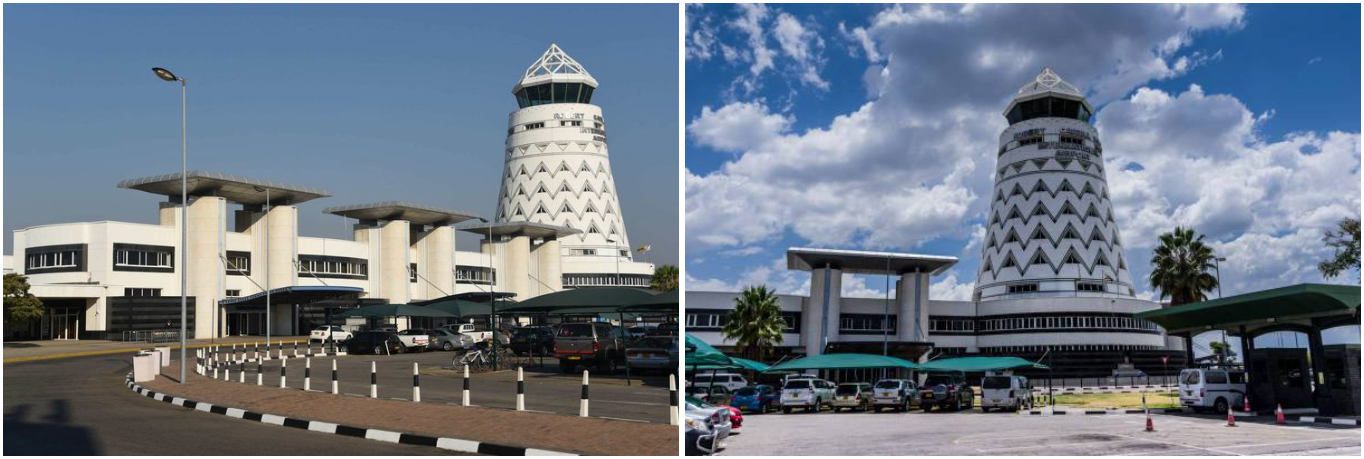
Huamei-Robert Gabriel Mugabe International Airport
For this airport project in Harare, Zimbabwe, Huamei supplied rubber insulation and glass wool insulation. The solution focused on airport building energy efficiency, infrastructure insulation, and HVAC temperature control. Rubber insulation materials were used to wrap condensate pipes in the air-conditioning system, helping maintain proper operating temperatures and reduce condensation risk in airport facilities.
This project demonstrates how Huamei’s airport thermal insulation materials can support large-scale airport expansion in hot-climate regions. By combining rubber foam for HVAC pipe insulation and glass wool for building insulation needs, Huamei helped the project address both operational energy efficiency and indoor environmental comfort.
For airport owners and engineering contractors, the Harare airport project is a practical example of how insulation materials contribute to long-term HVAC reliability, passenger comfort, and energy-saving operation.
Chengdu Shuangliu International Airport is one of the major aviation hubs in southwest China. As a modern international airport handling significant domestic and international passenger traffic, the project required insulation materials that could support safety, energy efficiency, comfort, and long-term building performance.
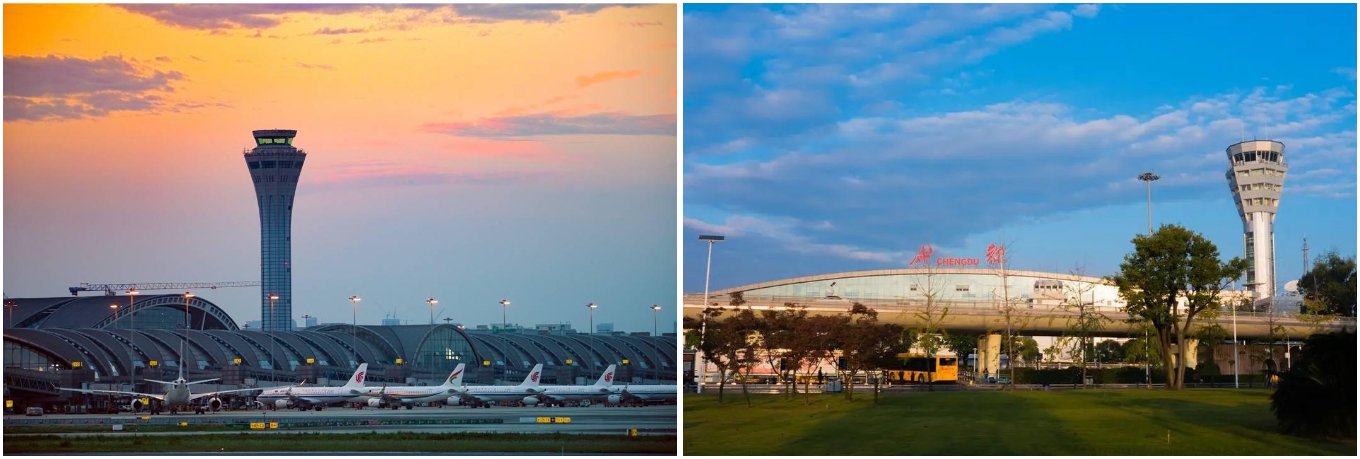
Huamei-Chengdu Shuangliu International Airport
For this airport project, Huamei supplied glass wool insulation and rock wool panels. Glass wool was selected for its thermal insulation and sound absorption performance, supporting comfortable indoor environments in large airport spaces. Rock wool panels were used to improve fire protection, pressure resistance, and durability in the airport building system.
The project reflects the real engineering demands of airport construction: large open spaces, long operating hours, strict safety standards, and the need to reduce building energy consumption. By using Huamei glass wool and rock wool panels, the airport project strengthened both building envelope performance and fire-safe construction.
This case highlights Huamei’s ability to provide insulation products for important transportation infrastructure projects where energy saving, fire resistance, and passenger comfort must be considered together.
Airport insulation projects require more than product supply. They require stable manufacturing capacity, consistent product quality, material selection support, and experience in large-scale public infrastructure. Huamei Energy-Saving Technology Group has long focused on thermal insulation and energy-saving materials, including rubber foam insulation, glass wool products, rock wool products, and other building insulation materials.
Huamei’s strengths for airport projects include:
A complete insulation material portfolio covering HVAC systems, ducts, pipes, roofs, walls, curtain walls, and fireproof building areas.
Large-scale manufacturing capacity to support airport construction schedules and bulk material demand.
Experience in major public infrastructure projects in China and international markets.
Product solutions designed for energy saving, thermal protection, acoustic comfort, and fire safety.
Support for contractors, distributors, and project buyers who need reliable Airport thermal insulation materials for different airport zones.
From HVAC pipe insulation to terminal roof and wall systems, Huamei can provide material combinations that match the real operating conditions of airport buildings.
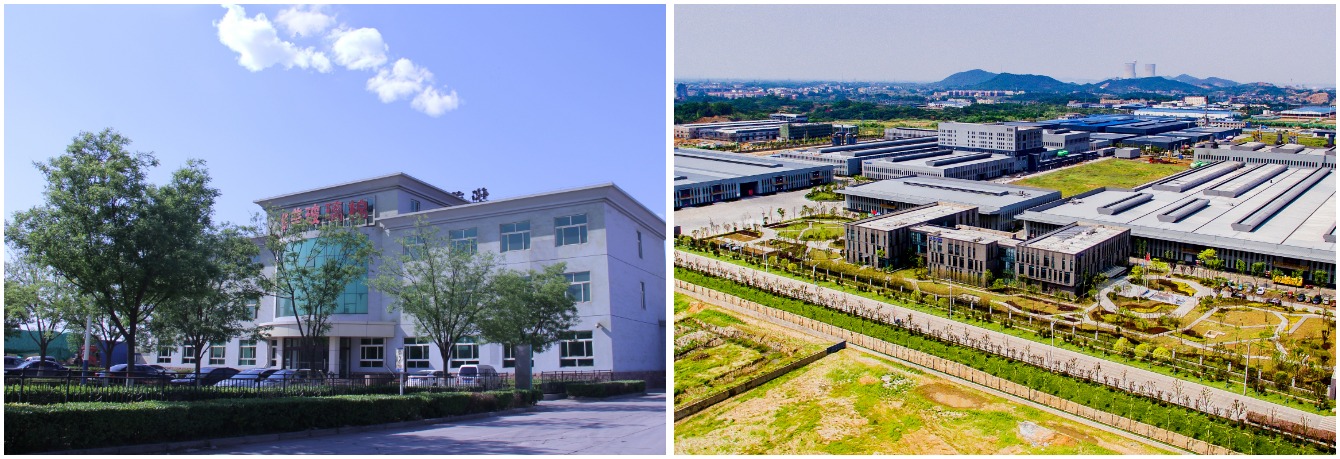
Huamei Company Building and Production Base
Rubber foam and glass wool help reduce thermal loss in chilled water systems, air-conditioning ducts, and mechanical service areas. This supports more stable HVAC operation and helps reduce unnecessary energy waste.
In chilled water and condensate systems, rubber foam insulation helps reduce surface condensation risk, protecting ceilings, equipment, and indoor areas from moisture-related problems.
Rock wool panels provide strong fire-resistant performance for curtain walls, roofs, partitions, and technical spaces. This is especially important for airport terminals and high-occupancy public buildings.
Glass wool and rock wool can improve acoustic performance by absorbing sound and reducing noise transmission. This helps create a more comfortable airport environment for passengers, staff, and commercial tenants.
Airport buildings are expected to operate continuously for many years. Durable insulation materials help protect building systems, reduce maintenance pressure, and support long-term performance.
Huamei’s multi-material solution allows airport projects to select rubber foam, glass wool, and rock wool panels according to different engineering needs, instead of relying on one material for all applications.
For new airport construction or airport renovation projects, insulation selection should begin with a clear analysis of building zones and operating conditions. Huamei recommends considering the following points:
Identify high-risk condensation areas such as chilled water pipes, condensate pipes, and cold air ducts.
Evaluate thermal loads in large terminal halls, roofs, façades, and service areas.
Select fire-resistant materials for curtain walls, roofs, partitions, equipment rooms, and evacuation-related zones.
Consider acoustic requirements in departure halls, arrival halls, baggage areas, and commercial zones.
Match insulation thickness, density, facing material, and installation method to project specifications.
Plan material supply early to support airport construction schedules and phased installation.
This engineering-based approach helps ensure that the final Airport energy-saving solution is practical, safe, and suitable for long-term operation.
Q:What are the most commonly used airport thermal insulation materials?
A:The most commonly used materials include rubber foam for HVAC pipes and ducts, glass wool for thermal and acoustic insulation, and rock wool panels for fire-resistant walls, roofs, curtain walls, and technical spaces.
Q:Why is rubber foam important for airport HVAC systems?
A:Rubber foam is important because it helps reduce heat transfer, control condensation, and protect chilled water and condensate pipelines. This supports stable HVAC performance in airport buildings.
Q:Where is glass wool used in airport construction?
A:Glass wool is commonly used in HVAC ducts, ceilings, roofs, partitions, and large terminal areas where thermal insulation and sound absorption are both required.
Q:Why are rock wool panels suitable for airport buildings?
A:Rock wool panels are suitable for airport buildings because they provide thermal insulation, fire resistance, pressure resistance, and long-term durability. They are especially useful in curtain walls, roofs, partitions, and equipment rooms.
Q:How does insulation contribute to airport energy saving?
A:Insulation reduces heat gain, heat loss, cooling waste, condensation problems, and HVAC load. When properly applied across pipes, ducts, roofs, walls, and technical areas, insulation becomes a key part of an airport energy-saving solution.
Airport construction requires insulation materials that can perform under high standards of safety, comfort, efficiency, and durability. With rubber foam, glass wool, and rock wool panels, Huamei provides integrated Airport thermal insulation materials for HVAC systems, building envelopes, fire protection areas, and passenger spaces.
From Robert Gabriel Mugabe International Airport in Zimbabwe to Chengdu Shuangliu International Airport in China, Huamei has demonstrated practical project experience in airport insulation and energy-saving construction. For airport owners, contractors, HVAC engineers, and building material distributors, Huamei offers reliable insulation solutions designed for real airport operating conditions.
Contact Huamei to discuss airport thermal insulation materials and customized Airport energy-saving solution options for your next airport construction or renovation project→
Copyright © Huamei Energy-saving Technology Group Co., Ltd. All Rights Reserved | Sitemap | Privacy Policy
Insulation solutions LIST: Insulation solutions LIST
