E-mail: marketing@hbhuamei.com
Cold chain transportation is no longer only a logistics issue. It has become a key part of food safety, pharmaceutical distribution, international trade, energy management, and carbon reduction. From refrigerated trucks and reefer containers to cold storage transfer areas, chilled distribution centers, and temperature-controlled pipelines, every link in the cold chain must maintain stable temperature conditions while controlling energy consumption.
For operators, contractors, equipment manufacturers, and project owners, insulation is one of the most practical ways to improve cold chain performance. A refrigeration unit can only perform efficiently when the insulated structure around it reduces heat gain, condensation risk, air leakage, and thermal bridging. This is why high-performance insulation materials are essential to Energy-saving solutions for cold chain transportation.
Huamei provides insulation materials for cold chain transportation systems, including rubber foam and glass wool products. These materials support stable temperature control, reduce cooling load, protect refrigerated equipment, and help cold chain operators build safer, more efficient, and more durable transport systems.
Cold chain transportation covers the movement of temperature-sensitive goods such as fresh food, frozen products, dairy products, meat, seafood, vaccines, pharmaceuticals, chemicals, and other perishable or sensitive cargo. These products depend on controlled temperatures from production to storage, loading, transport, unloading, and final delivery.
Unlike ordinary freight transport, cold chain transportation must overcome three constant challenges.
First, refrigerated vehicles and containers are exposed to changing outdoor temperatures, solar radiation, wind, rain, road vibration, and frequent door opening. Every temperature fluctuation increases the cooling load.
Second, refrigeration equipment consumes a large amount of energy. If the vehicle body, container wall, pipeline, or duct system is poorly insulated, the refrigeration unit must work harder and run longer to maintain the required temperature.
Third, condensation, moisture ingress, and frost formation can damage insulation systems and reduce long-term performance. In cold chain transportation, moisture control is as important as thermal insulation.
For this reason, Energy-saving solutions for cold chain transportation should not rely only on refrigeration equipment. A complete solution should combine efficient refrigeration, suitable refrigerants, reliable temperature monitoring, airtight construction, and high-performance insulation materials.
Insulation materials do not produce cooling, but they determine how efficiently cooling energy is protected. In refrigerated transportation, insulation works as a thermal barrier between the external environment and the controlled cargo space.
A well-designed insulation system can help:
Reduce heat transfer from the outside environment into the refrigerated space.
Lower the working load of compressors and refrigeration units.
Improve temperature stability during long-distance transportation.
Reduce the risk of condensation on cold surfaces.
Protect pipelines, ducts, valves, and equipment from thermal loss.
Improve energy efficiency during loading, unloading, and transit.
Support safer transportation of food, medicine, and temperature-sensitive goods.
Extend the service life of vehicle bodies, containers, and refrigeration systems.
In practical cold chain projects, different areas require different insulation materials. Rubber foam and glass wool do not perform the same function. Each material has its own role in Energy-saving solutions for cold chain transportation.
Rubber foam is one of the most important insulation materials for cold chain transportation because it combines low thermal conductivity, closed-cell structure, flexibility, moisture resistance, and ease of installation. These properties make it especially suitable for refrigerated systems where condensation control and energy efficiency are both required.
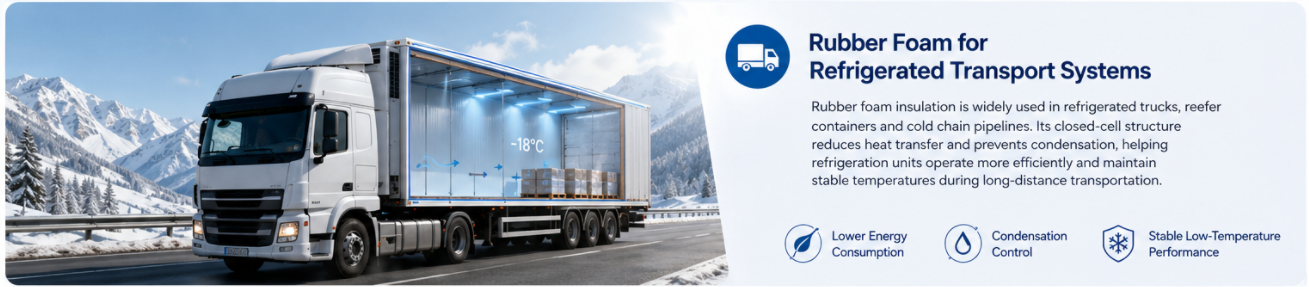
In cold chain transportation, rubber foam is commonly used for:
Refrigeration pipelines.
Chilled water pipes.
Air-conditioning ducts in refrigerated vehicles.
Valves and fittings.
Cold storage connection areas.
Reefer container auxiliary systems.
Transfer stations and cold logistics equipment.
Huamei cryogenic rubber foam is designed for low-temperature and cryogenic environments. Its closed-cell structure helps limit heat transfer and moisture penetration, while its flexible structure allows it to fit curved pipes, irregular surfaces, joints, and equipment connections. This is important because cold chain transportation systems often contain complex piping routes and compact installation spaces.
For refrigerated trucks and containers, rubber foam helps reduce thermal loss around refrigeration pipelines and auxiliary cooling systems. When pipes are not properly insulated, they may absorb heat from the surrounding air, causing the refrigeration unit to consume more energy. Rubber foam insulation helps maintain low temperatures inside the system and improves the overall efficiency of cold chain operation.
Another key function of rubber foam is condensation control. In cold chain systems, cold surfaces are exposed to warmer and more humid air during loading, unloading, maintenance, or operation in hot climates. If water vapor reaches cold surfaces, condensation may form. Over time, this can lead to corrosion, insulation failure, water dripping, frost formation, and energy loss. Closed-cell rubber foam helps reduce this risk by limiting moisture migration.
Cold chain transportation may involve chilled, frozen, and ultra-low-temperature conditions. Standard insulation materials may not always provide reliable performance under demanding low-temperature environments. Huamei cryogenic rubber foam is developed for applications where low thermal conductivity, flexibility, moisture resistance, and long-term durability are required.
The material is suitable for refrigeration systems, cold storage systems, cryogenic tanks, pipelines, refrigerated transport containers, and other low-temperature environments. Its low weight can help reduce additional load on pipelines and equipment, which is particularly valuable for mobile transportation systems.
The material also supports easier construction. Because it is flexible and easy to cut, it can be installed around pipes, elbows, valves, and irregular equipment surfaces. In cold chain transportation projects, this helps contractors improve installation efficiency and reduce thermal weak points caused by gaps or poorly fitted insulation.
For Energy-saving solutions for cold chain transportation, Huamei cryogenic rubber foam is positioned as a high-performance insulation material for cold-side equipment, refrigeration lines, and low-temperature systems where moisture control and stable insulation are critical.
Glass wool plays a different but equally important role in cold chain transportation. While rubber foam is often used for pipelines, ducts, and condensation-sensitive areas, glass wool is commonly used where lightweight thermal insulation, acoustic insulation, and fire performance are required.
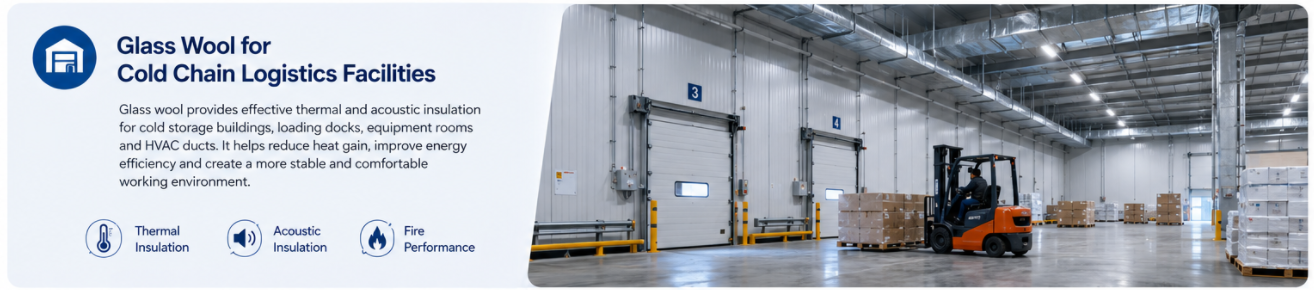
In cold chain transportation and cold logistics facilities, glass wool can be used in:
Cold chain transfer areas.
Refrigerated warehouse roofs and walls.
Temperature-controlled logistics buildings.
Equipment rooms.
HVAC ducts.
Vehicle or container auxiliary insulation layers, depending on system design.
Partition structures around cold logistics zones.
Glass wool is made from fine glass fibers that create air pockets, reducing heat transfer and supporting thermal insulation. It also has strong acoustic performance, which is useful in refrigeration equipment rooms, loading areas, and logistics facilities where compressors, fans, trucks, and handling equipment generate continuous noise.
For cold chain transportation systems, glass wool can support energy saving in facility-side infrastructure. Refrigerated vehicles and containers do not operate in isolation. They connect with loading docks, cold rooms, pre-cooling areas, distribution centers, and warehouse corridors. If these areas are not properly insulated, temperature fluctuations increase, and more cooling energy is required during loading and transfer.
Glass wool helps improve the building-side environment that supports cold chain transportation. By reducing heat gain through roofs, walls, partitions, and ducts, it helps create a more stable transition between cold storage and refrigerated transport.
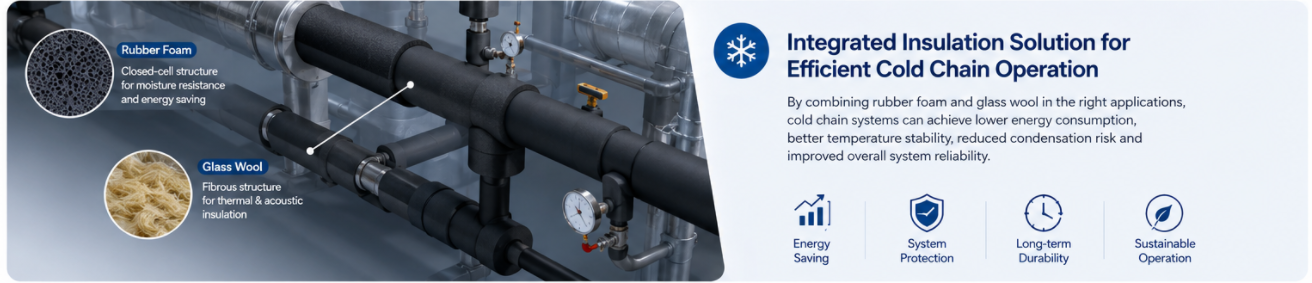
Rubber foam and glass wool should not be seen as competing materials in cold chain transportation. They are complementary materials used in different parts of the system.
Rubber foam is better suited for cold pipelines, refrigeration ducts, valves, fittings, equipment surfaces, and condensation-sensitive areas. It is especially valuable where the insulation layer must resist moisture, maintain flexibility, and fit complex shapes.
Glass wool is better suited for larger-area thermal insulation, acoustic insulation, HVAC ducts, walls, roofs, partitions, and cold logistics support facilities. It helps reduce building heat gain, improve acoustic comfort, and support fire safety requirements in cold chain infrastructure.
A complete Energy-saving solution for cold chain transportation often uses both materials together. Rubber foam protects the refrigeration system and cold-side technical components. Glass wool improves the thermal and acoustic performance of supporting buildings, transfer zones, and air-handling systems.
Refrigerated trucks operate under changing road and climate conditions. During transportation, heat enters through the vehicle envelope, door openings, pipe penetrations, and refrigeration system connections. Rubber foam can be used for refrigeration pipes, ducts, and auxiliary cooling components to reduce heat gain and condensation. Glass wool can be used in supporting logistics infrastructure and selected vehicle-related insulation systems where thermal and acoustic performance are required.
Reefer containers are widely used for international cold chain transportation. They must maintain stable temperatures during sea, rail, and road transport. Rubber foam insulation helps protect refrigeration lines and low-temperature components, reducing energy loss and improving operational stability. In port-side cold chain facilities and container service areas, glass wool can support insulated rooms, equipment areas, and duct systems.
Cold chain transportation depends heavily on loading and unloading efficiency. Poorly insulated loading areas can cause rapid temperature change, increasing refrigeration demand inside vehicles and storage rooms. Glass wool can help improve insulation for walls, roofs, ducts, and partitions, while rubber foam can be applied to chilled pipes and refrigeration equipment.
Pharmaceuticals, vaccines, biological products, and temperature-sensitive medical materials require reliable temperature control. Insulation materials used in these systems must help maintain stable conditions and reduce the risk of temperature excursions. Rubber foam is useful for refrigeration lines and cold equipment, while glass wool supports facility-side insulation and HVAC systems.
Fresh produce, meat, seafood, dairy, and frozen food require continuous temperature protection. Energy-efficient insulation helps reduce product deterioration caused by temperature fluctuation and supports more sustainable food logistics. Huamei rubber foam and glass wool can be used across different parts of food cold chain transportation systems, from refrigerated transport equipment to cold logistics buildings.
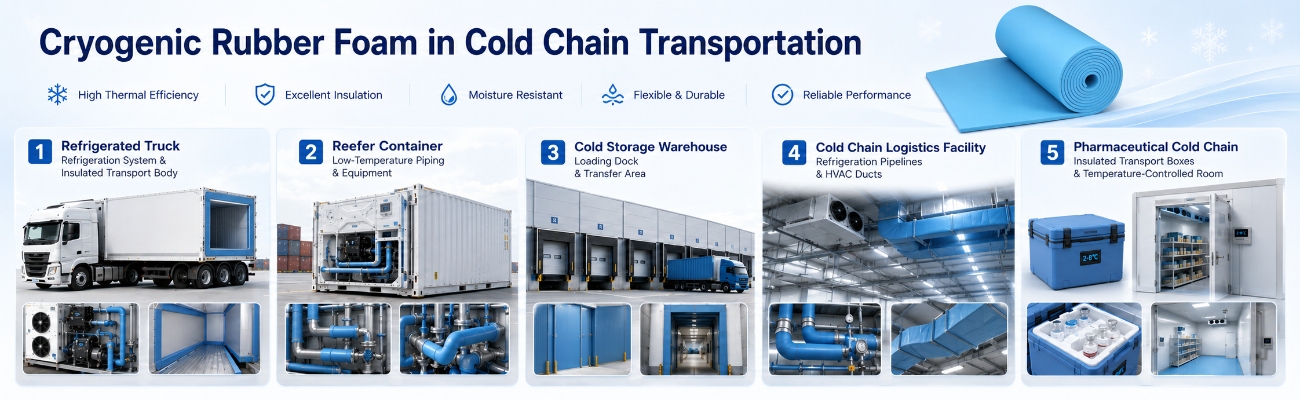
Huamei cryogenic rubber foam in cold chain transportation
Energy saving in cold chain transportation comes from reducing unnecessary cooling demand. Every watt of heat entering a refrigerated space must be removed by the refrigeration system. If insulation performance is poor, refrigeration equipment consumes more energy, runs more frequently, and experiences greater wear.
Huamei insulation materials support energy saving in several ways.
First, they reduce heat transfer. Rubber foam and glass wool both help slow down heat movement, which reduces cooling load and supports more stable temperature control.
Second, they help control condensation. Rubber foam’s closed-cell structure is especially valuable in cold-side systems because it helps reduce moisture penetration and surface condensation.
Third, they help maintain system efficiency over time. Durable insulation materials reduce the risk of insulation failure, water absorption, cracking, or deformation.
Fourth, they improve operational reliability. Stable insulation helps refrigeration equipment avoid frequent overload operation, which can support longer equipment life and lower maintenance demand.
Fifth, they support carbon reduction. By reducing refrigeration energy demand, Energy-saving solutions for cold chain transportation can help operators lower operating costs and improve sustainability performance.
To achieve reliable performance, cold chain insulation should be selected according to the actual operating environment. Buyers, engineers, and contractors should consider the following factors.
Operating temperature: Chilled, frozen, and cryogenic applications require different insulation thicknesses and material performance.
Moisture exposure: Areas exposed to humid air or frequent temperature change require strong condensation control.
Installation space: Refrigerated trucks, containers, and equipment rooms often have limited space, requiring flexible and easy-to-install materials.
Mechanical vibration: Transportation systems experience vibration, impact, and movement, so the insulation material must remain stable.
Fire safety: Logistics buildings, equipment rooms, and transport-related facilities may require materials with good fire performance.
Acoustic requirements: Refrigeration units and logistics equipment generate noise, making acoustic insulation important in some areas.
Maintenance access: Materials should support practical installation, inspection, and repair.
Long-term durability: Cold chain systems are expected to operate continuously, so insulation should maintain performance over time.
Huamei Energy-saving Technology Group provides insulation materials for a wide range of building, industrial, HVAC, and low-temperature applications. For cold chain transportation, Huamei offers rubber foam and glass wool products that can be integrated into refrigerated transport systems, cold logistics facilities, refrigeration pipelines, and supporting HVAC systems.
Huamei cryogenic rubber foam provides low-temperature insulation performance, moisture resistance, flexibility, low weight, and ease of installation. It is suitable for refrigeration pipelines, cold storage systems, refrigerated transport containers, and other low-temperature environments.
Huamei glass wool provides thermal insulation, acoustic insulation, fire resistance, and broad application flexibility. It can support cold chain logistics buildings, transfer areas, ducts, roofs, walls, partitions, and equipment spaces.
By combining these materials, Huamei helps customers build Energy-saving solutions for cold chain transportation that are practical, durable, and suitable for different project conditions.
Cold chain transportation will continue to grow as global demand increases for fresh food, frozen products, pharmaceuticals, and temperature-sensitive logistics. At the same time, operators are under pressure to reduce energy consumption, control operating costs, protect product quality, and improve sustainability.
Insulation is one of the most direct and long-lasting ways to improve cold chain efficiency. When selected and installed correctly, rubber foam and glass wool help reduce heat gain, control condensation, improve temperature stability, reduce refrigeration load, and support long-term energy saving.
Huamei provides reliable insulation materials for Energy-saving solutions for cold chain transportation, helping cold chain operators, contractors, and equipment manufacturers create safer, more efficient, and more sustainable temperature-controlled logistics systems.
Consulting on Energy-Saving Products for Huamei Cold Chain Transport→
Copyright © Huamei Energy-saving Technology Group Co., Ltd. All Rights Reserved | Sitemap | Privacy Policy
Insulation solutions LIST: Insulation solutions LIST
