E-mail: marketing@hbhuamei.com
Choosing the right sound absorbing foam thickness depends mainly on the type of noise you want to control, the frequency range involved, the available installation space, and how much acoustic treatment the room or equipment requires.
As a general rule, thinner sound absorbing foam is more suitable for controlling mid- and high-frequency reflections, while thicker foam can usually absorb sound across a broader frequency range and perform better at lower frequencies.
For many general acoustic applications, foam thicknesses around 25 mm to 50 mm are commonly considered first. Applications that require stronger broadband absorption may benefit from 50 mm, 75 mm, 100 mm, or thicker materials, depending on the acoustic design.
However, thickness alone does not determine performance. Foam structure, density, airflow resistance, surface design, mounting position, and the presence of an air gap can all affect the final result.
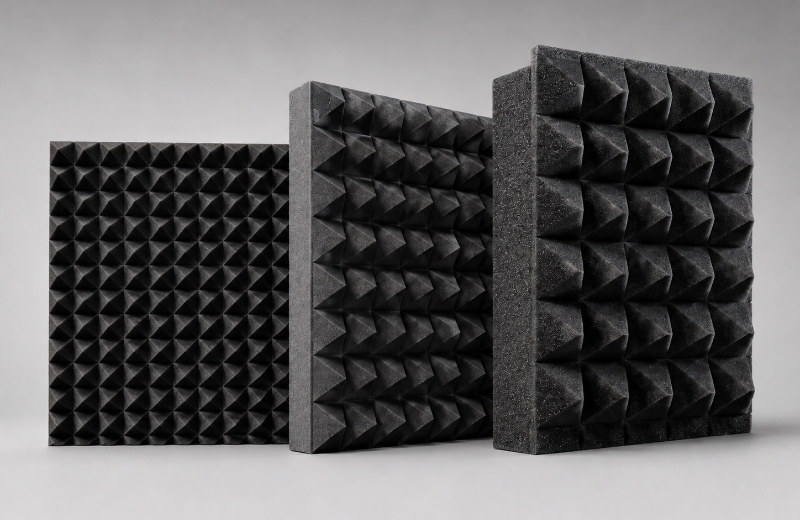
The following table provides a practical starting point when comparing different thicknesses.
| Foam Thickness | Typical Use | General Acoustic Focus |
|---|---|---|
| 10–25 mm | Light acoustic treatment, machinery surfaces, limited-space installations | Mainly mid and high frequencies |
| 25–50 mm | Offices, studios, meeting rooms, HVAC applications, equipment enclosures | Mid and high frequencies with improved broadband absorption |
| 50–75 mm | Rooms requiring stronger echo and reverberation control | Broader frequency range |
| 75–100 mm+ | More demanding acoustic environments and lower-frequency treatment | Improved broadband and lower-frequency absorption |
These ranges should be treated as selection guidelines rather than fixed performance ratings. The actual acoustic performance of a foam product should be evaluated using its tested sound absorption data and the requirements of the specific project.
Sound waves travel at different frequencies.
High-frequency sounds have shorter wavelengths, while low-frequency sounds have much longer wavelengths. Because of this difference, thin acoustic materials can interact relatively effectively with shorter-wavelength, higher-frequency sound, but they generally have more difficulty absorbing lower-frequency energy.
Increasing the thickness of the foam gives sound waves a deeper porous or cellular structure through which to travel.
As sound enters the material, acoustic energy is gradually dissipated through friction and internal resistance within the material structure.
This is why thicker sound absorbing materials generally provide better broadband absorption.
In simple terms:
Thin foam → mainly helps control higher-frequency reflections
Thicker foam → can extend useful absorption toward lower frequencies
But choosing the thickest available foam is not always necessary or economical.
A 25 mm sound absorbing foam can be suitable when the main goal is to reduce common reflections, echo, and reverberation in the mid- and high-frequency range.
Typical applications may include:
Offices
Meeting rooms
Small studios
Equipment housings
HVAC ducts
Machinery surfaces
Commercial interiors
For example, speech contains a significant amount of acoustic energy in the mid-frequency range. If a room feels overly reflective because of hard walls, ceilings, glass, or other smooth surfaces, relatively thin acoustic treatment may already make a noticeable difference.
A 25 mm foam may also be useful where installation space is limited.
However, if the project involves stronger low-frequency noise or requires more broadband absorption, increasing the material thickness should be considered.
A 50 mm sound absorbing foam is often a more versatile option for general-purpose acoustic treatment.
Compared with thinner foam, additional thickness allows the material to interact with a wider range of sound frequencies.
It may be suitable for:
Recording and rehearsal spaces
Home theaters
Conference rooms
Industrial equipment enclosures
Mechanical rooms
Commercial acoustic treatment
Transportation equipment
If you are choosing between 25 mm and 50 mm foam and have enough installation space, 50 mm is often worth considering when broader sound absorption is required.
However, performance should still be based on actual product specifications rather than thickness alone.
Thicker acoustic foam becomes more useful when controlling lower frequencies is increasingly important.
Examples may include spaces or equipment affected by:
Heavy machinery
Ventilation equipment
Compressors
Motors
Low-frequency room resonance
Entertainment sound systems
Industrial production equipment
In these situations, 75 mm or 100 mm material may provide broader absorption than a thin surface treatment.
But there is an important limitation.
Even very thick sound absorbing foam should not automatically be considered a complete solution for low-frequency sound isolation.
Low-frequency noise is difficult to control because of its long wavelength and high ability to travel through building structures.
If the objective is to prevent sound from passing through a wall, floor, or ceiling, the project may require other sound insulation strategies such as:
Higher-mass materials
Decoupled wall or ceiling structures
Vibration isolation
Resilient layers
Sealing of air gaps
Multilayer acoustic assemblies
Sound absorbing foam primarily controls sound energy within a space or around a noise source. It should not be confused with a complete soundproofing barrier.
Not necessarily.
Increasing thickness can improve acoustic performance, but only when the additional material addresses the actual acoustic problem.
For example, if a room mainly suffers from high-frequency reflections caused by speech, glass, concrete walls, or metal surfaces, installing extremely thick foam may provide limited practical benefit compared with a properly designed thinner treatment.
The better approach is to match foam thickness to the problem.
Consider four questions:
Identify whether the main problem is:
Speech
Machinery noise
Fan noise
HVAC noise
Music
Echo
Reverberation
Equipment vibration
Different sound sources contain different frequency ranges.
This distinction is important.
Sound absorption reduces reflected sound inside a space.
Sound insulation reduces sound transmission between different spaces.
If your main problem is excessive reverberation, sound absorbing foam may be appropriate.
If your problem is noise passing through a wall, simply installing thicker acoustic foam on the wall may not provide the result you expect.
In equipment, HVAC, ductwork, transportation, and building applications, acoustic performance must often be balanced against available space.
For example, a 100 mm material may provide useful acoustic benefits but may not be practical inside a compact equipment enclosure.
A thinner material with suitable acoustic properties may therefore be the better engineering choice.
Never select sound absorbing material based only on thickness.
Where available, review laboratory performance data such as:
Frequency-dependent absorption
NRC
Density
Material structure
Fire performance
Thermal conductivity
Moisture resistance
Two foam materials with the same thickness can behave very differently because their internal structures are different.
Density matters, but higher density does not automatically mean better sound absorption.
Acoustic performance depends on how sound waves interact with the internal structure of the material.
For porous sound absorbers, factors such as:
Cell structure
Porosity
Airflow resistance
Thickness
Density
Surface geometry
all contribute to acoustic behavior.
A material that is too resistant to airflow may reflect more acoustic energy instead of allowing sound waves to enter the material effectively.
For this reason, thickness and density should be evaluated together rather than independently.
Not exactly.
Open-cell foam contains interconnected pores that allow sound waves to penetrate into the material. This structure is commonly associated with acoustic absorption because sound energy can enter the pores and dissipate internally.
Closed-cell foam has sealed cells and generally behaves differently acoustically. Depending on its formulation, it may also provide useful properties such as:
Thermal insulation
Moisture resistance
Condensation control
Vibration damping
Mechanical protection
For industrial projects, the choice therefore may not be based purely on maximum sound absorption.
A material may need to provide several functions simultaneously, including acoustic control, thermal insulation, fire performance, moisture resistance, and durability.
Yes, installation design can affect acoustic performance.
Placing an absorbing material directly against a hard wall is not always the only configuration.
In some acoustic systems, leaving an air gap between the sound absorbing material and the wall or ceiling can improve absorption at lower frequencies compared with attaching the same material directly to the surface.
This happens because the air cavity effectively increases the acoustic depth of the treatment.
Therefore, when installation space allows, it may be possible to improve performance without simply increasing foam thickness.
The optimal air gap depends on the material, frequency range, and acoustic design.
For reducing speech reflections and general reverberation, relatively thin to medium-thickness acoustic treatment is usually the first option considered.
A starting range may be:
25–50 mm
The final thickness depends on room size, surface materials, ceiling height, and the amount of acoustic coverage.
Studios often require broader frequency control than ordinary offices.
A typical project may therefore use:
50 mm or thicker panels
Thicker absorbers or specialized bass traps may also be added in selected locations such as corners.
HVAC acoustic treatment must balance sound absorption with:
Available duct space
Airflow
Thermal performance
Moisture conditions
Fire requirements
Thickness may range considerably depending on the system design.
Rather than selecting the thickest material available, engineers should evaluate acoustic performance together with thermal and mechanical requirements.
Industrial equipment may generate a combination of:
Airborne noise
Vibration
Mid-frequency noise
Low-frequency mechanical noise
Foam thickness should therefore be selected together with enclosure design and vibration-control measures.
For many industrial applications, a multilayer approach can be more effective than relying on one thick foam layer alone.
A practical selection process can be summarized in five steps.
Step 1: Identify the noise source
Determine whether the noise comes from speech, machinery, ventilation, music, equipment, or other sources.
Step 2: Determine the frequency range
Find out whether the problem is mainly high-, mid-, or low-frequency sound.
Step 3: Define the acoustic objective
Decide whether you need to reduce echo, control reverberation, absorb equipment noise, reduce vibration, or block sound transmission.
Step 4: Check available installation space
Determine the maximum practical material thickness.
Step 5: Compare tested product performance
Evaluate thickness together with material structure, density, fire rating, environmental conditions, and frequency-dependent sound absorption.
For general acoustic treatment, 25–50 mm sound absorbing foam is a practical starting point.
Choose thinner foam when:
Space is limited
The main problem is mid- or high-frequency reflection
Only moderate reverberation control is required
Consider thicker foam when:
Broader-frequency absorption is required
Lower-frequency noise is more significant
The acoustic environment is more demanding
Installation space allows additional material depth
Most importantly, do not choose acoustic foam based on thickness alone.
The best sound absorbing foam is the one that matches the noise frequency, acoustic objective, material structure, installation method, and environmental requirements of the project.
For commercial buildings, HVAC systems, industrial equipment, transportation, and other specialized applications, selecting the right thickness based on project conditions can provide better acoustic performance while avoiding unnecessary material and installation costs.
Copyright © Huamei Energy-saving Technology Group Co., Ltd. All Rights Reserved | Sitemap | Privacy Policy
Insulation solutions LIST: Insulation solutions LIST
