E-mail: marketing@hbhuamei.com
Rock wool insulation offers strong environmental benefits when a project requires long-term thermal efficiency, fire resistance, dimensional stability, moisture tolerance, and durable performance. Although rock wool production requires high-temperature melting and therefore consumes energy during manufacturing, its overall environmental value should be assessed across the complete building life cycle. Stable insulation performance can reduce heating and cooling demand for decades, while the material’s non-combustible mineral composition and recycling potential can help reduce replacement, reconstruction, and disposal impacts. Buyers evaluating the Rock Wool Insulation Environmental Impact can explore rock wool insulation products for walls, roofs, industrial equipment, curtain walls, and other demanding applications.
The environmental performance of insulation cannot be judged by a single factor such as recycled content, product weight, or manufacturing energy. A material with a relatively low initial carbon footprint may require earlier replacement, additional fire protection, or more complicated moisture-control systems. By contrast, a durable insulation product that maintains its thermal and mechanical properties over a long service life may deliver greater environmental benefits during actual use.
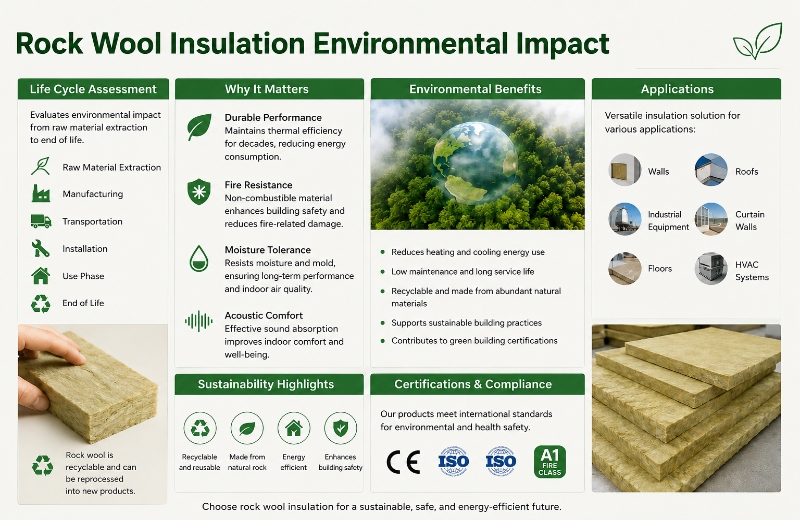
The environmental impact of rock wool insulation includes every stage from raw-material extraction to end-of-life treatment. A proper comparison should evaluate equivalent insulation performance rather than compare materials only by weight or volume.
The main life-cycle stages include:
Raw-material extraction and transportation
Manufacturing energy consumption
Production emissions and waste
Packaging and international transportation
Installation waste and handling requirements
Heating and cooling energy savings
Maintenance and replacement frequency
Fire and moisture-related durability
Reuse, recycling, or final disposal
For purchasing and project evaluation, the most meaningful question is not whether one kilogram of rock wool has a lower impact than one kilogram of another material. The correct question is which material can deliver the required thermal resistance, fire performance, acoustic control, durability, and service life with the lowest overall environmental burden.
The largest environmental benefit of most insulation materials occurs after installation. Buildings consume energy continuously for heating, cooling, ventilation, and temperature control. A properly installed insulation system reduces heat transfer through walls, roofs, ceilings, floors, pipelines, ducts, and industrial equipment.
Rock wool has a stable fibrous structure that does not depend on a trapped blowing gas for thermal performance. When the product is correctly specified and protected within the building assembly, it can retain its thickness and thermal properties over a long operating period.
Long-term stability can provide several environmental advantages:
Lower heating energy consumption in cold climates
Reduced air-conditioning demand in hot climates
More stable indoor temperatures
Less frequent HVAC operation
Reduced heat loss from industrial equipment
Lower risk of insulation gaps caused by shrinkage
Less replacement waste during the building life cycle
An insulation product that settles, deforms, absorbs persistent moisture, or develops gaps may gradually lose performance. This can increase operational energy consumption and create additional environmental impacts from removal, transportation, and replacement.
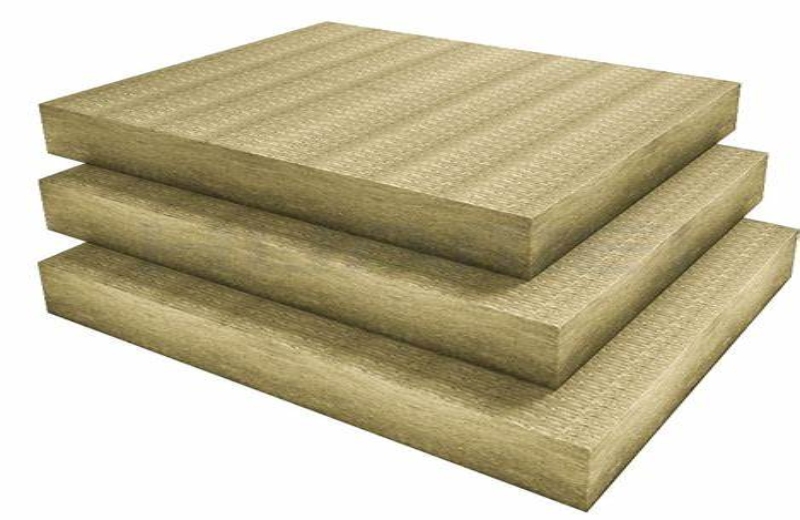
Rock wool insulation is valued for its dimensional stability. High-quality rock wool boards can resist shrinkage, deformation, and settlement under normal service conditions.
This stability is particularly important in:
Exterior wall insulation systems
Ventilated façades
Flat roofing systems
Metal roofs
Curtain wall fire barriers
Industrial furnaces and equipment
High-temperature pipelines
Acoustic partitions
When insulation remains continuous and stable, the building envelope can maintain its designed thermal performance for a longer period. A longer service life reduces the need for replacement materials, transportation, labor, and waste disposal.
Rock wool is primarily manufactured from basalt, dolomite, and other mineral raw materials. These materials are widely available and do not rely mainly on virgin petrochemical feedstocks.
Some rock wool manufacturing processes can also incorporate recycled mineral materials or production waste. The exact recycled content varies according to the manufacturer, product formulation, production facility, and local material supply.
Using abundant mineral resources does not automatically make every rock wool product sustainable. Manufacturing efficiency, energy sources, emission treatment, and waste recovery must also be considered. However, mineral-based feedstocks can provide greater resource stability than insulation materials that depend heavily on petroleum-derived raw materials.
Rock wool offcuts and clean recovered mineral wool can be processed and reused in new insulation production where suitable recycling systems are available.
Potential circularity benefits include:
Recovery of production offcuts
Reuse of clean installation waste
Reduced demand for virgin mineral raw materials
Lower quantities of insulation sent to landfill
Recycling of selected demolition material
Improved material efficiency within manufacturing plants
Actual recyclability depends on local infrastructure and the condition of the recovered insulation. Rock wool that has been mixed with mortar, adhesives, membranes, coatings, dust, or other demolition waste may be more difficult to recycle.
Buyers should therefore ask suppliers whether manufacturing waste is recovered and whether product take-back or recycling services are available in the project region.
Rock wool is made from inorganic mineral fibers and is widely used in fire-resistant building systems. Depending on the product and applicable testing standard, rock wool insulation can achieve high fire-performance classifications.
Fire safety also has an environmental dimension. A serious building fire can cause:
Loss of construction materials
Smoke and air pollution
Contaminated demolition waste
Damage to equipment and property
Large-scale reconstruction
Additional transportation and manufacturing emissions
Using non-combustible insulation in properly tested assemblies can help improve building resilience and reduce the risk of extensive material loss.
Fire performance must always be confirmed according to the specific product, density, thickness, facing material, assembly design, installation method, and local standard. A general material description should not replace project-specific test documentation.
Rock wool achieves its insulating performance by trapping air within a network of mineral fibers. It does not require a foam blowing agent to form its internal structure.
This is an important difference between rock wool and several foam insulation materials. Some rigid foam and spray foam products use blowing agents during production or installation. The environmental impact of these products can vary significantly according to the blowing agent, polymer type, manufacturing process, and product generation.
Modern foam products may use lower-global-warming-potential blowing agents, but the exact formulation should still be verified. Buyers should compare product-specific environmental documentation rather than assume that all foam insulation has the same environmental impact.
Rock wool is inorganic and does not provide a direct food source for mold. Many rock wool products are treated to resist liquid water while remaining vapor permeable.
This can support the drying performance of correctly designed wall and roof assemblies. Moisture tolerance is important because wet or damaged insulation may lose thermal efficiency and require premature replacement.
However, rock wool should not be treated as a substitute for proper waterproofing. The complete system must still include suitable:
Vapor-control layers
Drainage systems
Air barriers
Flashing
Roof coverings
Façade detailing
When moisture is correctly managed, rock wool can maintain stable performance in exterior walls, roofs, curtain walls, industrial systems, and humid operating environments.
Rock wool can provide several functions within one insulation layer, including:
Thermal insulation
Fire resistance
Sound absorption
Dimensional stability
Moisture tolerance
High-temperature resistance
In some projects, this multifunctional performance can reduce the need for additional fire-protection, acoustic, or support materials.
Reducing the number of separate layers may simplify specification, installation, maintenance, and future material separation. Nevertheless, the environmental impact should always be assessed at the complete system level rather than based only on the insulation product.
No insulation material is the most environmentally friendly choice in every application. Each material has advantages and limitations related to manufacturing, transportation, installation, durability, fire safety, moisture, and end-of-life recovery.
| Material | Main Raw Materials | Manufacturing Considerations | Long-Term Performance | Fire and Moisture Factors | End-of-Life Potential |
|---|---|---|---|---|---|
| Rock Wool | Basalt, dolomite, mineral materials, and possible recycled mineral content | High-temperature melting requires energy, but production waste may be reused | Strong dimensional stability and long service life | Non-combustible and moisture tolerant when correctly installed | Recyclable where collection and processing systems are available |
| Fiberglass | Sand, glass, and recycled glass | Melting requires energy, but products are usually lightweight | Good thermal performance, although compression and installation quality are important | Generally non-combustible, but lower-density products may have less mechanical strength | Recycling availability varies by region |
| Cellulose | Recycled paper fiber | Often has relatively low embodied impact but requires chemical treatments | Can fill irregular cavities but may settle if installed incorrectly | Combustible feedstock treated with fire retardants and sensitive to prolonged moisture | High recycled content, but post-use recovery can be difficult |
| EPS, XPS, PIR, or Spray Foam | Mainly petrochemical feedstocks | Impact depends on polymer type, blowing agent, density, and plant technology | High thermal resistance per unit thickness, but some products may shrink or age | Often moisture resistant, but combustible materials require tested protection | Recycling can be difficult when bonded or contaminated |
| Natural Fiber Insulation | Wood fiber, hemp, cork, cotton, or sheep wool | Renewable feedstocks may reduce embodied carbon, but binders and treatments matter | Performance varies according to density, climate, and installation | Fire and moisture resistance must be verified for each product | Reuse, recycling, or biological recovery may be possible |
A balanced evaluation must also recognize the limitations of rock wool.
Rock wool is produced by melting mineral raw materials at very high temperatures. This process requires substantial energy.
The actual manufacturing impact depends on:
Fuel source
Electricity mix
Furnace efficiency
Recycled material content
Heat recovery
Production scale
Emission-control systems
Buyers should request product-specific environmental information instead of relying only on general industry claims.
Rock wool is normally denser than fiberglass and several foam products. Greater density can increase transportation emissions if packaging and container loading are not optimized.
Transportation impact can be reduced through:
Efficient board dimensions
Compressed packaging where applicable
Optimized pallet sizes
Full-container loading
Suitable production locations
Reduced packaging damage
Accurate order planning
Although rock wool is technically recyclable, practical recycling depends on local collection and processing facilities.
Contamination from mortar, adhesives, membranes, coatings, and demolition waste can make recovery more difficult. Buyers should confirm whether recycling is available near the construction site.
Incorrect measurements or cutting can create unnecessary waste. Projects should use accurate specifications, cutting plans, and suitable board sizes to reduce offcuts.
Before placing an order, purchasing teams should request evidence that supports the environmental performance of the selected product.
Ask whether the supplier can provide:
Environmental Product Declarations
ISO 14001 certification
Energy-management information
Recycled-content documentation
Material composition declarations
Manufacturing emission information
Waste-recovery procedures
Environmental comparisons should use products that provide the same:
Thermal resistance
Fire classification
Insulation area
Service life
Acoustic performance
Compressive strength
Moisture resistance
Comparing products only by kilogram or purchase price may produce an inaccurate conclusion.
Ask how the material performs under:
Temperature variation
Vibration
Compression
Humidity
High-temperature operation
Long-term vertical installation
A durable insulation system can reduce maintenance, replacement, and waste.
International buyers should review:
Pallet dimensions
Package compression
Container loading quantity
Moisture protection
Edge protection
Port transportation
Damage-prevention measures
Efficient logistics can reduce transportation cost and environmental impact.
Fire, thermal, water-repellency, compressive-strength, and dimensional-stability data should match the specific product ordered.
The environmental benefits of rock wool insulation are most significant when the product remains in service for many years and performs several functions within one building or industrial system. Stable thermal efficiency, non-combustible mineral composition, sound absorption, moisture tolerance, and recycling potential can help reduce operational energy use, replacement frequency, and material waste.
However, not every rock wool product has the same density, thermal conductivity, fire classification, compressive strength, or environmental documentation. International buyers should select products according to the actual application rather than use one standard specification for every project.
To request product specifications, test reports, certificates, packaging information, container-loading details, samples, or a quotation, contact Huamei with your required thickness, density, application, order quantity, destination port, and applicable standard. Our team will help you select a rock wool insulation solution that balances environmental performance, fire safety, durability, and total purchasing cost.
Copyright © Huamei Energy-saving Technology Group Co., Ltd. All Rights Reserved | Sitemap | Privacy Policy
Insulation solutions LIST: Insulation solutions LIST
