E-mail: marketing@hbhuamei.com
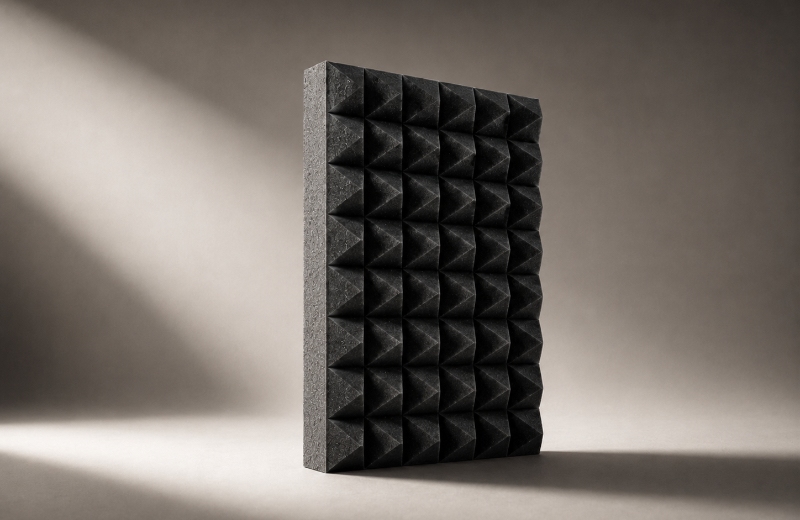
Installing sound absorbing foam in the right location is just as important as choosing the right material and thickness. Covering every wall with foam is rarely necessary. In most spaces, better results come from placing acoustic treatment where sound reflections are strongest or closest to the noise source.
In general, sound absorbing foam should be installed on first-reflection points, hard wall surfaces, ceilings, corners, and around noise-producing equipment where reflected sound and reverberation are most noticeable.
The best placement depends on the room, noise source, frequency range, and acoustic objective.
Sound travels outward from its source and reflects from hard surfaces such as:
Concrete walls
Glass
Metal panels
Ceilings
Floors
Machinery housings
Duct walls
These reflections can create echo, reverberation, and excessive overall noise.
Sound absorbing foam works by allowing acoustic energy to enter the material and dissipate within its cellular structure.
However, foam can only absorb sound effectively when sound waves actually reach the treated surface.
This means that placing foam randomly around a room may use more material without providing proportionally better acoustic performance.
A better approach is to identify the surfaces receiving the strongest reflections and treat those areas first.
First-reflection points are usually among the most important locations for sound absorbing foam.
These are the surfaces where sound first reflects after leaving the source before reaching the listener.
For example, in a meeting room, sound from a speaker may travel directly toward listeners while another portion reflects from nearby walls or the ceiling.
These early reflections can reduce speech clarity and make the room sound more reverberant.
Installing foam at these reflection points can help reduce the amount of reflected sound returning into the room.
Typical first-reflection areas include:
Side walls
Front or rear walls
Ceilings
Surfaces opposite speakers
Hard surfaces near machinery
For many rooms, treating these locations can be more effective than distributing small foam pieces randomly across every surface.
A wall directly facing a major sound source often receives a large amount of acoustic energy.
Examples include:
A wall opposite loudspeakers
A wall facing production machinery
The inside wall of an equipment enclosure
Walls near ventilation equipment
If this surface is hard and reflective, sound can bounce back into the space.
Adding sound absorbing foam to these surfaces can help reduce reflected acoustic energy and control reverberation.
However, the best coverage depends on the noise source and room geometry. Full-wall treatment is not always necessary.
Strategically treating the areas with the highest reflection intensity can often provide a more efficient solution.
Yes. Ceilings can be an important treatment area, especially in spaces with many hard surfaces.
Sound does not only travel horizontally. It also reflects vertically between the floor and ceiling.
Ceiling treatment can therefore be useful in:
Offices
Conference rooms
Factories
Workshops
Restaurants
Studios
Equipment rooms
Commercial buildings
Rooms with concrete, metal, or other reflective ceilings can experience particularly noticeable reverberation.
Installing sound absorbing material overhead can reduce these vertical reflections.
This can be especially useful when wall space is limited because of windows, shelves, machinery, pipes, or other equipment.
In some applications, yes.
The wall behind or around speakers can contribute to unwanted reflections, particularly when speakers are positioned close to a hard surface.
Acoustic foam installed around these areas can help manage reflected sound.
However, foam placement should depend on the actual acoustic problem.
For example, if the main problem comes from reflections on side walls or the rear wall, treating only the wall behind the speakers may not provide enough improvement.
A more effective approach is to consider the complete sound path:
Sound source → reflecting surface → listener
This helps determine where absorption is most useful.
The rear wall can be another important treatment location.
Sound traveling past the listener may reflect from the rear wall and return into the room.
This can create:
Late reflections
Flutter echo
Increased reverberation
Reduced speech clarity
Reduced sound definition
Rooms with short distances between the listener and the rear wall can be particularly sensitive to these reflections.
Adding sound absorbing material to selected areas of the rear wall may therefore improve acoustic control.
Corners require special consideration.
Room corners often accumulate more low-frequency acoustic energy than flat wall surfaces.
However, ordinary thin foam installed flat in a corner may not provide sufficient low-frequency control.
For stronger low-frequency problems, thicker absorbers or specialized corner treatments may be needed.
Corner treatment can be useful in:
Recording rooms
Music rooms
Home theaters
Mechanical rooms
Equipment enclosures
If the main problem is low-frequency noise, simply adding more thin foam to the walls may not provide the expected result.
The thickness, depth, and mounting configuration become much more important.
Industrial sound control often requires a different approach from ordinary room acoustics.
Machines can generate sound from several sources, including:
Motors
Compressors
Fans
Pumps
Mechanical impacts
Rotating components
Airflow
In machinery applications, sound absorbing foam is often installed on the inside surfaces of equipment enclosures or barriers.
Typical locations include:
Interior enclosure walls
Equipment covers
Acoustic hoods
Machine guards
Nearby reflective panels
The objective is to absorb sound inside the enclosure before it reflects repeatedly and escapes into the surrounding workspace.
Where possible, foam should be positioned near the acoustic source without interfering with:
Ventilation
Moving components
Maintenance access
Electrical systems
Fire safety requirements
Industrial applications therefore require both acoustic and engineering considerations.
HVAC systems can generate noise from fans, compressors, airflow, and vibration.
Acoustic treatment may be used in:
Duct interiors
Air-handling units
Equipment housings
Mechanical rooms
Ventilation enclosures
Within duct systems, sound absorbing materials may help reduce noise traveling along the airflow path.
However, HVAC applications require additional consideration because the material may be exposed to:
Continuous airflow
Temperature changes
Condensation
Moisture
Dust
Mechanical wear
For this reason, material selection should consider more than acoustic performance alone.
Fire performance, thermal properties, moisture resistance, durability, and installation requirements may all influence the final solution.
Usually not.
One of the most common misconceptions about acoustic treatment is that more foam always produces better results.
In reality, completely covering every wall may create an acoustically over-damped environment while increasing material and installation costs.
For many applications, partial coverage can provide sufficient reverberation control when the foam is positioned correctly.
A more effective process is to:
Identify the main sound source.
Find the strongest reflection points.
Treat the most reflective surfaces first.
Evaluate the acoustic result.
Add additional absorption only where needed.
The required coverage depends on:
Room volume
Surface materials
Noise level
Frequency range
Foam thickness
Acoustic performance
Intended use of the space
There is therefore no universal percentage of wall coverage that works for every project.
Both arrangements can work, depending on the objective.
Spreading panels across several reflective surfaces can provide more even acoustic control throughout a room.
Grouping thicker absorbers in strategic locations may be more useful when targeting stronger reflections or specific frequency ranges.
For general reverberation reduction, distributing absorption across multiple surfaces can help prevent untreated areas from continuing to generate strong reflections.
For localized industrial noise, concentrating treatment near the sound source may be more efficient.
The placement strategy should therefore match the type of acoustic problem.
In some installations, yes.
Mounting sound absorbing material with a small air space behind it can improve acoustic performance, especially toward lower frequencies.
The air cavity effectively increases the acoustic depth of the treatment.
For example, a foam panel mounted directly against a wall behaves differently from the same panel installed with an air gap behind it.
However, the ideal gap depends on:
Foam thickness
Material structure
Frequency range
Available space
Installation method
An air gap should therefore be considered as part of the overall acoustic design rather than as a fixed requirement.
Some installation locations provide relatively little acoustic benefit.
For example, placing foam:
Behind large cabinets
Behind sealed wall panels
Inside completely blocked cavities
Under objects that prevent sound from reaching the material
may significantly reduce its effectiveness.
The absorbing surface should generally remain exposed to the acoustic field.
Furniture and equipment placement should therefore be considered when planning the treatment.
Different noise problems require different foam placement strategies.
| Acoustic Problem | Recommended Starting Location |
|---|---|
| Speech reverberation | Side walls and ceiling |
| Flutter echo | Opposing parallel walls |
| Speaker reflections | First-reflection points |
| Machinery noise | Inside equipment enclosures |
| HVAC noise | Ducts, housings, mechanical rooms |
| General room echo | Walls and ceiling |
| Low-frequency buildup | Corners and thicker treatment areas |
This table should be treated as a general guide.
Actual acoustic treatment should be based on the source location, frequency range, building structure, and required performance.
When possible, treating sound near the source can be very effective.
If acoustic energy can be absorbed before it spreads throughout the space, fewer reflected sound waves may reach distant surfaces.
This is particularly useful for:
Machinery
Compressors
Fans
Generators
Equipment enclosures
In room acoustics, however, treating reflection points between the source and listener can also be important.
Therefore, placement depends on whether the goal is:
Source control
or
Room reflection control
Industrial noise applications often emphasize source control, while studios, offices, and meeting rooms usually require more attention to the complete room acoustic environment.
The best acoustic location is not automatically the safest or most practical installation location.
Before installing foam, check whether the area is exposed to:
High temperatures
Open flames
Moisture
Condensation
Oil
Chemicals
Strong airflow
Mechanical abrasion
In commercial and industrial environments, fire performance may be particularly important.
The selected foam should therefore meet the relevant requirements for the installation environment.
Acoustic performance should always be evaluated together with safety, durability, thermal performance, and maintenance requirements.
A practical installation process can follow six steps.
Determine where the sound originates.
This may be a speaker, machine, fan, compressor, HVAC unit, or group of people.
Look for nearby hard surfaces such as:
Concrete
Glass
Metal
Tile
Gypsum board
Hard ceilings
These surfaces are more likely to reflect sound.
Determine where sound first reaches nearby walls and ceilings after leaving the source.
These areas are usually strong candidates for acoustic treatment.
If the problem mainly involves speech and high-frequency reflections, wall and ceiling treatment may be sufficient.
If low-frequency noise is significant, thicker materials, corner treatment, air gaps, or other acoustic systems may be required.
Make sure the foam will not interfere with:
Ventilation
Maintenance
Electrical components
Moving equipment
Fire protection systems
Acoustic treatment is often most effective when installed progressively.
Treat the most important surfaces first, then evaluate whether additional coverage is necessary.
For most applications, the best locations are surfaces receiving the strongest sound reflections or areas close to the noise source.
Start with:
First-reflection points
Side walls
Ceilings
Walls facing the sound source
Rear walls
Equipment enclosure interiors
HVAC ducts and housings
Corners when low-frequency control is required
Avoid simply covering every available surface.
The best acoustic solution combines the right foam material, thickness, placement, coverage area, and installation method.
For offices, HVAC systems, industrial machinery, transportation equipment, and other commercial applications, evaluating the actual sound source and reflection path before installation can improve acoustic performance while reducing unnecessary material use.
Copyright © Huamei Energy-saving Technology Group Co., Ltd. All Rights Reserved | Sitemap | Privacy Policy
Insulation solutions LIST: Insulation solutions LIST
