E-mail: marketing@hbhuamei.com
As global building standards continue to emphasize energy efficiency, thermal insulation, and moisture control, Foil-clad glass wool has become one of the most widely adopted insulation materials across construction and industrial sectors. By combining high-performance glass wool with aluminum foil facings, this product delivers enhanced thermal reflection, vapor resistance, and long-term durability.
This article provides a clear overview of Foil-clad glass wool product types and highlights the most commonly used configurations in the current market, helping buyers, contractors, and engineers make informed material selections.
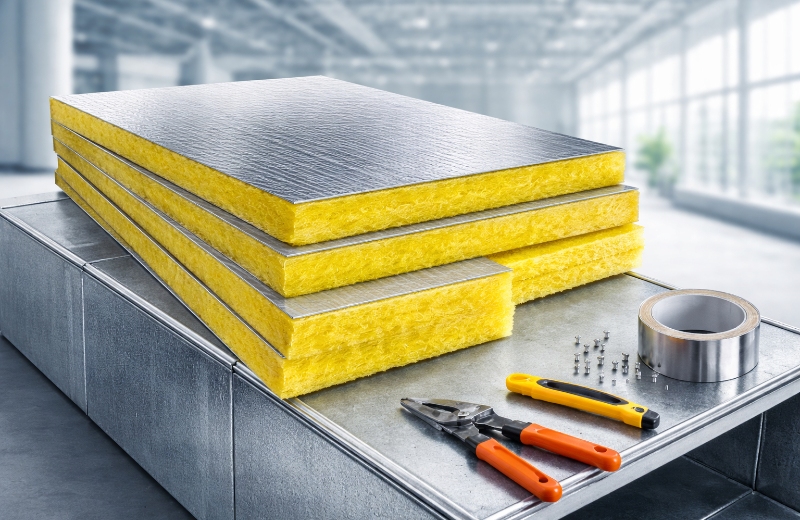
Foil-clad glass wool is a thermal insulation material manufactured from glass fibers bonded into mats, boards, or blankets, with an aluminum foil facing laminated on one or both sides.
The aluminum foil acts as a radiant heat barrier and vapor retarder, significantly improving insulation efficiency while protecting the glass wool core from moisture ingress.
This combination makes Foil-clad glass wool especially suitable for HVAC systems, building envelopes, industrial insulation, and energy-efficient construction projects.
Based on structure, application, and facing type, Foil-clad glass wool in today’s market can be categorized into the following main product types:
Rigid boards laminated with reinforced aluminum foil, commonly used for:
External and internal wall insulation
Roof and ceiling systems
Steel structure buildings and prefabricated constructions
These boards offer high compressive strength, dimensional stability, and consistent thermal performance.
Flexible roll insulation with aluminum foil facing, widely applied in:
HVAC air ducts
Pipe and equipment insulation
Industrial thermal systems
This type is valued for its easy installation, adaptability to curved surfaces, and cost efficiency.
FSK (Foil-Scrim-Kraft) reinforced products combine aluminum foil with fiberglass scrim and kraft paper, enhancing:
Tensile strength
Tear resistance
Long-term durability
This structure is one of the most commonly specified options in HVAC duct insulation.
Featuring micro-perforated aluminum foil, this type allows sound absorption while maintaining thermal insulation, making it suitable for:
Acoustic panels
Mechanical rooms
Noise-sensitive industrial environments
Used where insulation remains visible, offering both functional performance and improved aesthetics.
Industry demand shows a clear preference for FSK reinforced aluminum foil-clad glass wool blankets and boards, especially in HVAC and commercial construction projects.
| Application Area | Share of Foil-Clad Glass Wool Usage |
|---|---|
| HVAC ducts & ventilation systems | ~42% |
| Building walls & roofs | ~33% |
| Industrial equipment & pipelines | ~17% |
| Acoustic & specialty applications | ~8% |
Key Insight:
FSK foil-clad glass wool blankets dominate the HVAC sector due to their balance of thermal efficiency, vapor resistance, and installation speed.
| Thickness (mm) | Typical Use Case | Market Adoption |
|---|---|---|
| 25–30 mm | Light duct insulation | Medium |
| 40–50 mm | Standard HVAC & wall insulation | High |
| 75–100 mm | High-performance building envelopes | Growing |
Medium-density Foil-clad glass wool (24–48 kg/m³) remains the most frequently specified range, offering optimal insulation without excessive material weight.
Compared with non-faced glass wool, Foil-clad glass wool delivers measurable advantages:
Improved thermal resistance through radiant heat reflection
Effective vapor barrier reducing condensation risk
Enhanced mechanical strength during installation
Longer service life in humid or temperature-variable environments
Compliance with modern energy-saving building standards
These benefits explain why Foil-clad glass wool is increasingly chosen for green buildings, energy retrofits, and industrial insulation upgrades.
As global construction moves toward low-energy buildings and carbon-reduction targets, demand for Foil-clad glass wool is expected to grow steadily. HVAC modernization, prefabricated buildings, and industrial energy optimization projects will continue to be the primary growth drivers.
Manufacturers offering custom thickness, density, and foil configurations are best positioned to meet evolving project requirements.
1. What is the difference between Foil-clad glass wool and plain glass wool?
Foil-clad glass wool includes an aluminum foil facing that improves heat reflection and provides a vapor barrier, while plain glass wool does not.
2. Which Foil-clad glass wool type is most commonly used?
FSK reinforced aluminum foil-clad glass wool blankets are the most widely used, especially for HVAC duct insulation.
3. Is Foil-clad glass wool suitable for humid environments?
Yes. The aluminum foil facing helps prevent moisture penetration and reduces condensation risk.
4. Can Foil-clad glass wool be used for sound insulation?
Perforated foil-clad glass wool is designed for combined thermal and acoustic performance.
5. What thickness should be selected for HVAC applications?
Thicknesses of 40–50 mm are the most common choice for standard HVAC duct insulation projects.
Copyright © Huamei Energy-saving Technology Group Co., Ltd. All Rights Reserved | Sitemap | Privacy Policy
Insulation solutions LIST: Insulation solutions LIST
