E-mail: marketing@hbhuamei.com
With the rapid development of modern healthcare, biotechnology, and pharmaceutical research, the medical industry increasingly relies on low-temperature and cryogenic environments. From vaccine preservation and biological sample storage to medical gas delivery and advanced diagnostic equipment, maintaining stable ultra-low temperatures has become a critical requirement.
In this context, Cryogenic Rubber Foam has emerged as a high-performance insulation material specifically suited for extreme low-temperature environments. Cryogenic Rubber Foam for medical applications plays a vital role in ensuring thermal stability, system safety, and long-term operational reliability across a wide range of healthcare facilities.
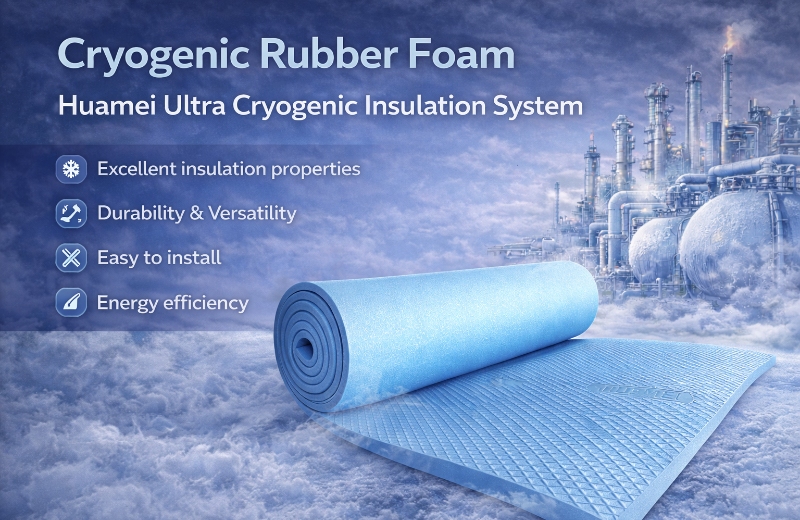
Cryogenic Rubber Foam is a closed-cell elastomeric insulation material engineered for cryogenic and ultra-low temperature conditions. Unlike conventional rubber foam insulation, it is specially formulated to maintain flexibility, structural integrity, and thermal efficiency even at extremely low temperatures.
Key characteristics of Cryogenic Rubber Foam for medical applications include:
A highly uniform closed-cell structure
Exceptional resistance to thermal shock
Stable insulation performance in cryogenic environments
Compatibility with complex medical systems and piping layouts
These properties make Cryogenic Rubber Foam a preferred insulation solution in medical environments where temperature stability and hygiene standards are critical.
One of the most significant advantages of Cryogenic Rubber Foam for medical applications is its extremely low thermal conductivity at cryogenic temperatures. This allows medical systems to maintain precise temperature control while minimizing energy loss, even in continuous operation.
At ultra-low temperatures, many traditional insulation materials become brittle and prone to cracking. Cryogenic Rubber Foam, however, retains elasticity and mechanical strength, reducing the risk of insulation failure in medical cryogenic systems.
The closed-cell structure of Cryogenic Rubber Foam ensures very low water absorption. This is particularly important in medical environments, where condensation can compromise equipment performance, hygiene, and safety.
Cryogenic Rubber Foam for medical applications demonstrates strong resistance to chemicals, cleaning agents, and environmental aging, supporting long service life in hospitals, laboratories, and pharmaceutical facilities.
In medical cold chain systems, maintaining consistent ultra-low temperatures is essential for:
Vaccine storage
Blood and plasma preservation
Biopharmaceutical products
Biological samples and tissues
Cryogenic Rubber Foam is widely used to insulate cryogenic storage tanks, cold rooms, and transport pipelines, ensuring temperature stability and reducing thermal loss during storage and transportation.
Hospitals and research centers rely on medical gases such as liquid oxygen and liquid nitrogen. Cryogenic Rubber Foam for medical applications provides reliable insulation for:
Cryogenic pipelines
Valves and fittings
Medical gas distribution systems
By minimizing heat ingress, Cryogenic Rubber Foam helps prevent gas evaporation, frost formation, and energy waste.
Advanced medical equipment often operates under cryogenic conditions, including:
MRI systems
Cryotherapy equipment
Cryogenic freezers
Laboratory testing instruments
In these applications, Cryogenic Rubber Foam protects surrounding components from extreme cold while maintaining system efficiency and operational safety.
Beyond individual devices, Cryogenic Rubber Foam for medical applications is increasingly used in hospital infrastructure, such as:
Cryogenic machine rooms
Low-temperature laboratories
Medical research facilities
Its flexibility allows easy installation on complex piping systems, supporting modern hospital design and maintenance requirements.
When compared with conventional insulation materials such as polyurethane (PU), polyisocyanurate (PIR), or mineral wool, Cryogenic Rubber Foam offers clear advantages in medical cryogenic environments:
Better flexibility at ultra-low temperatures
Reduced risk of cracking and insulation gaps
Superior condensation control
Easier installation and maintenance
Improved long-term performance stability
For these reasons, Cryogenic Rubber Foam for medical applications is increasingly specified in healthcare projects requiring high-performance cryogenic insulation.
Medical facilities impose strict requirements on material safety, durability, and reliability. Cryogenic Rubber Foam is well suited to meet these expectations due to:
Stable material composition
Low outgassing characteristics
Compatibility with clean and controlled environments
In Cryogenic Rubber Foam for medical applications, insulation performance must align with international standards for medical gas systems, cryogenic storage, and healthcare facility construction, supporting safe and compliant operation.
As precision medicine, cell therapy, and biotechnology continue to evolve, the demand for ultra-low temperature systems will grow significantly. Cryogenic Rubber Foam for medical applications is expected to play an even more important role in:
Ultra-low temperature biobanking
Advanced pharmaceutical research
High-efficiency medical gas infrastructure
Customized cryogenic insulation solutions
Ongoing material innovation will further enhance the thermal efficiency, durability, and sustainability of Cryogenic Rubber Foam, supporting next-generation medical technologies.
Cryogenic Rubber Foam has become an indispensable insulation solution for modern healthcare systems operating in cryogenic environments. From medical gas pipelines and cold chain logistics to advanced diagnostic equipment and hospital infrastructure, Cryogenic Rubber Foam for medical applications delivers reliable thermal insulation, long-term durability, and operational safety.
By combining excellent low-temperature performance with flexibility and moisture resistance, Cryogenic Rubber Foam helps medical facilities achieve stable, efficient, and compliant cryogenic operations—supporting the future of healthcare and medical innovation.
Copyright © Huamei Energy-saving Technology Group Co., Ltd. All Rights Reserved | Sitemap | Privacy Policy
Insulation solutions LIST: Insulation solutions LIST
